Digital Art & NFT Exhibitions in Darmstadt: What Will Be Important Soon (Guide for Upcoming Dates)
Darmstadt connects art, science, and technology like hardly any other city. Anyone who wants to experience digital art in the coming months and years—from VR/AR installations to early NFT formats—will find the right places to go here and a clear approach to reliably discover future exhibitions.
What “digital art” will often mean in Darmstadt in the future
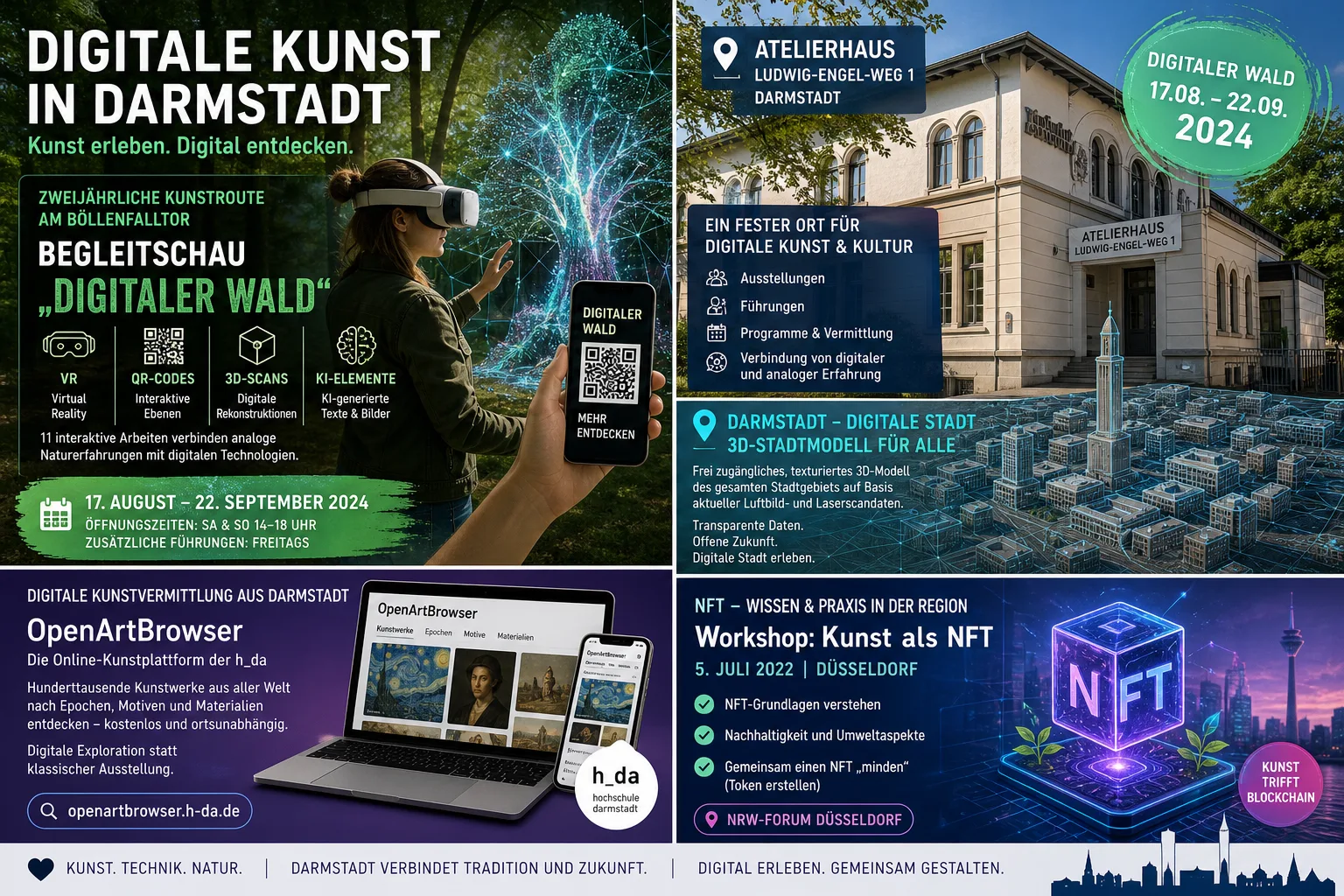
When Darmstadt presents digital art in the coming seasons, experience shows that it is less about “a screen on the wall”—and more often about formats that combine interaction, space, and data. Typical (future) exhibition forms are:
VR experiences (Virtual Reality): Visitors move through fully digital spaces with a headset.
AR elements (Augmented Reality): Digital layers are placed over real locations via smartphone/tablet.
QR-supported art routes: Stations in the urban space or in parks lead to digital content, audio, 3D objects, or web installations.
3D scanning & photogrammetry: Real objects/places are translated into digital models that serve as artworks or as stages.
AI-based works: Generative images, texts, or sound—ideally implemented with transparent labeling and context.
For visitors, a change of perspective is worthwhile: With digital art, not only the “work” is important, but also the usage (interface), the framing (curation), and the traceability (transparency about technology, data, and rights).
Where you can most reliably find upcoming exhibitions & events
Because programs can be announced or updated at short notice, the safest strategy is a mix of official channels and curated calendars. For Darmstadt, this works particularly well in practice through:
Official websites of the respective venues/initiatives (program, press/news, newsletter).
Social media accounts of the organizers (announcements, date changes, additional dates, ticket links).
Municipal event calendars and cultural portals (for bundled overviews).
University-related channels (departments, labs, exhibition spaces, project weeks, public presentations).
Tip for planning: If you are specifically looking for digital art, filter future programs by keywords such as VR, AR, immersive, interactive, generative, AI, 3D, sound, net art, blockchain, or NFT.
Atelierhaus at Ludwig-Engel-Weg 1: Likely Hotspot for Upcoming Formats
The Atelierhaus at Ludwig-Engel-Weg 1 (Darmstadt) is a particularly obvious place when it comes to upcoming digital exhibitions, educational offerings, and experimental formats—especially when projects require flexible room layouts, set-up and dismantling areas, and direct proximity to artistic production.
What visitors can typically expect at such venues in future programs:
Introductions that make technology (VR/AR, projection, sensors) understandable.
Talks with artists about processes, data sources, copyright, and publication.
Accompanying formats such as short workshops (e.g., “How does an interactive installation work?”).
From the E-E-A-T perspective, it is particularly important in digital art that organizers explain in an understandable way how a work functions (e.g., whether it collects data, whether AI models are used, whether content is hosted online) and what barriers exist (motion sickness in VR, accessibility, languages, volume, light).
VR/AR & QR Formats: This Is How Future Visits Typically Work
If an upcoming exhibition is announced as “immersive” or “interactive,” it helps to know the process before your visit. Common patterns:
Time slots/reservation: VR stations are often limited; a slot prevents waiting times.
Short briefing: Operation, safety (cables, boundaries), hygiene rules for the headset.
Experience phase: 5–20 minutes per work are common; often with sound.
Reflection zone: Text panels, making-of, Q&A, sometimes a “second look” in the browser.
If QR codes are part of a future art route, pay attention to:
Data protection: If possible, use your smartphone’s preview function and preferably open links via known domains.
Battery level & data volume: AR and 3D models can be larger.
Accessibility: Good projects offer alternatives (subtitles, text transcripts, audio descriptions).
Darmstadt’s 3D City Model: Stage for Future Art in Urban Space
When Darmstadt extends digital infrastructure (such as 3D city models, geodata, or visualizations) into cultural projects, a particularly exciting future perspective emerges: The city can serve as a digital stage—without every idea having to be physically built immediately.
Realistic use cases for upcoming projects include:
Virtual pre-stagings: Curators can test planned installations in the digital urban space (lines of sight, scale, lighting effect).
AR art trails: Digital sculptures or text/sound layers are linked to real locations.
Digital twins as narrative spaces: Artistic works can link city history, present, and future as a walkable simulation.
The added value for visitors is clear: They experience art not only “in the house,” but as a route, playground, or research—and can access the same work (depending on the concept) both on site and later online.
NFT, Blockchain & Metaverse: Realistic Scenarios for Upcoming Darmstadt Programs
NFTs (Non-Fungible Tokens) are often described as “proof of ownership for digital art.” Technically, NFTs are unique tokens on a blockchain that refer to a digital object or to metadata. In future Darmstadt contexts, the hype is less relevant—but rather the question of where NFTs actually make curatorial sense.
What is plausible in Darmstadt in the future
NFTs as edition/supporting format: An upcoming exhibition could offer optional digital editions without the exhibition visit itself becoming “crypto-heavy.”
Provenance & archiving: For digital works, a traceable version and ownership history can (depending on implementation) become part of the concept.
Hybrid mediation: A work exists physically (installation) and additionally as a digital component that lives on online.
What you should pay attention to with future NFT offerings (visitor check)
Clear rights information: What exactly are you acquiring (display/usage rights, edition, file, only token reference)?
Transparent costs: Minting/transaction fees and wallet requirements should be explained in advance in an understandable way.
Sustainability: Organizers should explain which blockchain is used and why.
Risk notice: NFTs are not a guaranteed store of value; reputable cultural formats focus on content, not speculation.
Important: If an upcoming event advertises with “Metaverse,” it is worth taking a look at the concrete implementation. Reputable programs name the platform, hardware requirements, accessibility, data protection, and moderation in advance—instead of just using a buzzword.
This Is How You Plan Your Next Visit (Checklist)
With this checklist, you can find and enjoy upcoming digital art formats in Darmstadt without surprises:
Check the program: Date, time, duration, slots/reservation.
Clarify technical requirements: VR on site or your own smartphone/headset?