Discover Riding Stables & Horse Farms around Darmstadt
Discover Riding Stables & Horse Farms around Darmstadt: Offers, Selection Criteria, and Trends for the Coming Years
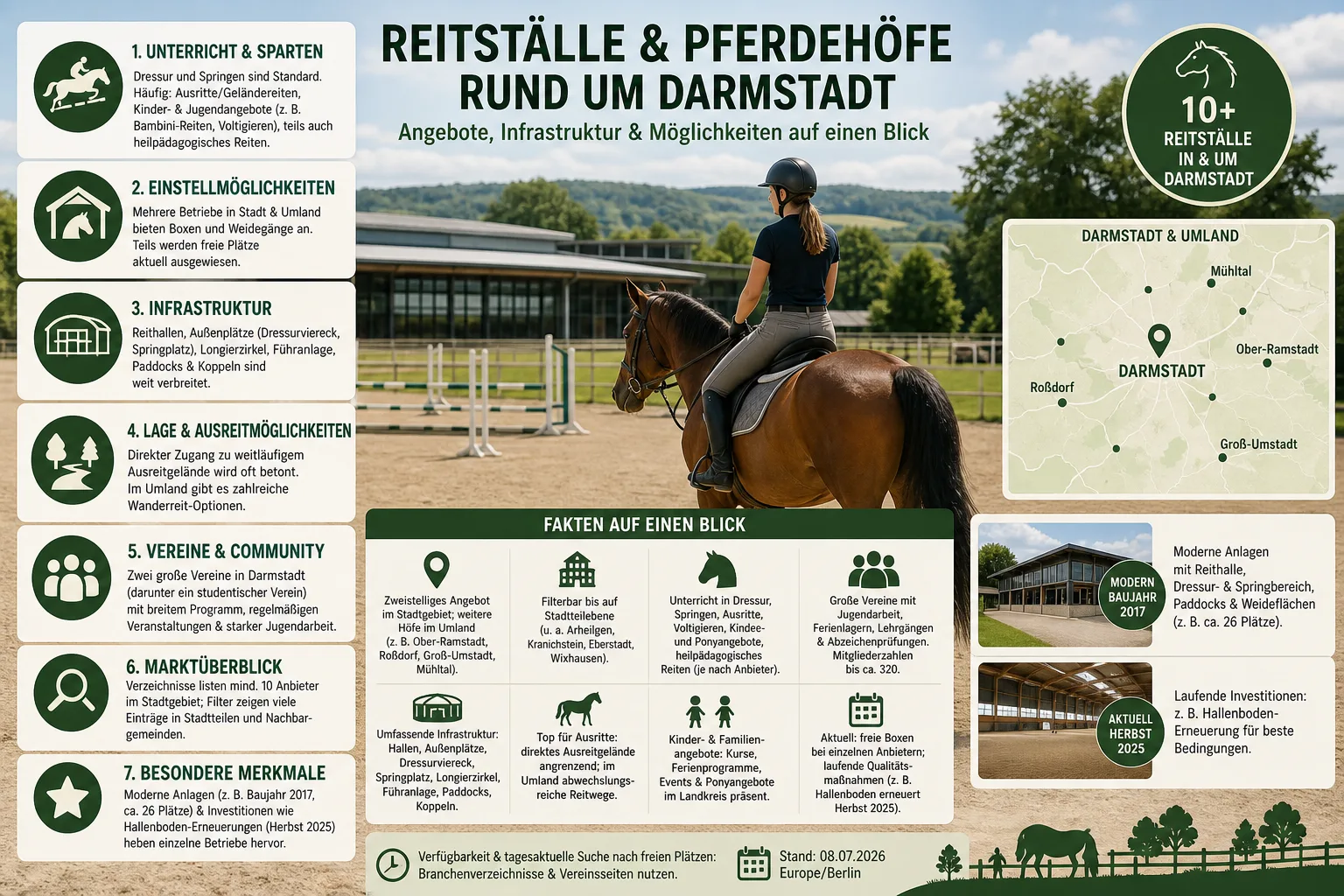
If you want to learn to ride, get back into riding, or find a place for your own horse around Darmstadt in the future, you will benefit from short distances between the city, stable, and riding areas. This guide shows what offers are typically to be expected in the region, what you should pay attention to when making your choice, and which developments are likely to shape equestrian sports in the coming years.
Riding Landscape around Darmstadt: What to Expect in the Future
In the coming months and years, you will likely find a wide selection of riding stables, horse farms, and riding clubs around Darmstadt – both in locations close to the city and in the surrounding communities. For many, this means: riding lessons or stable visits can often be easily combined with everyday life, studies, or work.
When searching, it is worth paying attention to:
- Location & Accessibility: Connections by car, bicycle, or public transport, parking options, and safe routes to the stable.
- Focus: Riding school operation, sports club, breeding/raising, horse boarding, or a focus on children's and family offers.
- Terrain: Proximity to forest and field paths, riding trail networks, and suitable routes for relaxed rides.
- Transparency: Clear information about lessons, care, animal welfare concepts, and safety rules.
If you are new to the region, it is best to plan several visits for your selection. This way, you can calmly compare whether the atmosphere, teaching philosophy, and daily stable life match your goals.
Riding Lessons: Getting Started, Building Up, Planning Competition Goals
If you want to (re)start riding in Darmstadt and the surrounding area in the future, you will typically find lessons in the English riding style – mainly dressage and jumping, often supplemented by trail rides or cross-country offers. Many businesses structure their programs so that both beginners and advanced riders can find suitable formats.
Formats You Can Often Expect in the Region
- Beginner Courses: Basics of handling, grooming, saddling, safety rules, and first riding exercises.
- Regular Group Lessons: Technique development, seat training, and systematic training.
- Private Lessons: Individual corrections, targeted support, or re-entry after breaks.
- Vaulting & Pony Offers: For children, often a safe, playful introduction focusing on balance and teamwork.
- Holiday Courses: Multi-day programs combining practice (riding/care) and theory (e.g., horse behavior, hooves, feeding).
- Therapeutic or Curative Educational Offers: If available, qualifications, objectives, and framework conditions are particularly important.
Important Questions to Ask Before You Start
- How are school horses used (working hours, breaks, health management)?
- What safety standards apply (helmet requirement, safety vest recommendation, behavior in the arena/on the farm)?
- How large are the groups and how are they divided by skill level?
- What goals does the instruction support (leisure riding, badges, competition preparation)?
For teenagers, students, and families, it may also be worthwhile to look for club structures: In the coming years, experience shows that there will be more courses, badge exams, and community events planned there, which make the learning path easier.
Boarding Places & Horse Boarding: Stable Types and Questions for Visits
If you are looking for a boarding place around Darmstadt in the coming months, you should expect changing availability. Many businesses work with waiting lists or allocate places after a get-to-know-you appointment to ensure that horse and husbandry concept fit together.
Stable Types You Will Often Encounter
- Box Housing: Often combined with paddock or pasture times according to schedule.
- Outdoor Boxes: Often with more air circulation; depending on the business, with paddock option.
- Open Stable/Group Housing: Movement and social contact are the focus; management (feeding, hierarchy, blankets) should be clearly regulated.
- Paddock Trail/Movement Stables: Trending in some regions if infrastructure and space are available.
Checklist for the Visit (Practical)
- Animal Welfare & Movement: How many hours per day are pasture/paddock realistically planned? Are there winter and bad weather concepts?
- Feeding: Hay quality, feeding rhythm, options for special needs (e.g., allergies, metabolic issues).
- Hygiene & Health: Deworming/vaccination management (according to vet plan), quarantine rules, emergency procedures.
- Safety: Fences, gates, arena rules, visitor guidance, storage of feed/medication.
- Services & Communication: What is included (mucking out, turnout, blanket service)? How are changes communicated?
- Training Opportunities: Arena times, arena maintenance, lunging options, possibly lessons on site.
Allow enough time for your decision: Changing stables is organizationally and emotionally demanding for the horse. Transparent agreements on services, rules, and expectations are the best protection against later misunderstandings.
Infrastructure: Arenas, Paddocks, and Riding Opportunities
Year-round training in the coming years will depend more than ever on good infrastructure – especially in extreme weather. Around Darmstadt, you will find different facilities depending on the business, which directly influence your training (and your horse's health).
Typical Features to Look Out For
- Indoor Arena(s): For weather-independent training, lessons, and safe winter months.
- Outdoor Arenas: Ideally with lighting and regular maintenance.
- Ground Quality: Ask about maintenance intervals, watering, and usage concept (avoid overuse).
- Lunging Ring/Work Areas: For gentle build-up training, groundwork, and rehab phases.
- Access to Trails: Direct access to field and forest paths reduces stress when "riding out" and increases training variety.
For trail rides in the future: Plan your routes in advance, respect agriculture and natural areas, and inform yourself about local regulations (e.g., trail requirements, protected areas). This ensures that riding out remains possible and conflict-free in the long term.
Clubs, Community & Events: How to Connect
If you want to not only ride but also settle in the region in the future, riding clubs and farm communities often provide the quickest access. In the coming years, formats will likely continue to be offered that go beyond lessons and make it easier to get started.
Events You Will Often Find Throughout the Year
- Introductory and Info Days: To get to know the stable, trainers, and routines.
- Courses: Seat training, jumping gymnastics, dressage intensive days, groundwork, or cross-country training.
- Badge Courses: Structured preparation with theory and practice (depending on offer and demand).
- Holiday Programs: Especially for children and teenagers, often designed as multi-day courses.
- Club and Farm Events: Parties, internal competition days, or theme days around horses.
If you want to get involved, ask: In many clubs, helping hands are sought for events, youth programs, or organization in the coming seasons. This is often the best way to make contacts and gain insights.
Outlook: Trends for the Coming Years
Riding stables and horse farms will likely continue to adapt to three major topics in the coming years: animal welfare, economic viability, and sustainable land use. For riders and boarders, this can be positive – if quality and transparency increase.
Developments You Will Likely See More Often around Darmstadt
- More Focus on Movement: Concepts with more turnout times, paddock use, and clear movement plans are likely to become more important.
- Quality over Pure Size: Businesses will be more convincing with clear care concepts, well-maintained grounds, and reliable routines than just with maximum capacity.
- Transparent Communication: Digital channels (websites, booking systems, info groups) will likely become more important to keep availability, rules, and dates up to date.
- Grassroots Sports & Young Talent: Children's and youth formats as well as safe beginner offers will probably remain a central building block to attract new target groups.
- Safety and Skills Development: More structured theory (handling, emergencies, horse behavior) will likely be increasingly integrated into courses.
If you are planning your next steps, a simple but effective approach is worthwhile: define your goal (leisure riding, safe re-entry, athletic development, boarding place with lots of turnout) and then specifically visit two to four suitable businesses. This way, you make a decision that will last for years to come.