How Darmstadt is Becoming a Smart City
How Darmstadt is Becoming a Smart City: What’s Planned Next (2026–2030)
8 min readLaura Müller
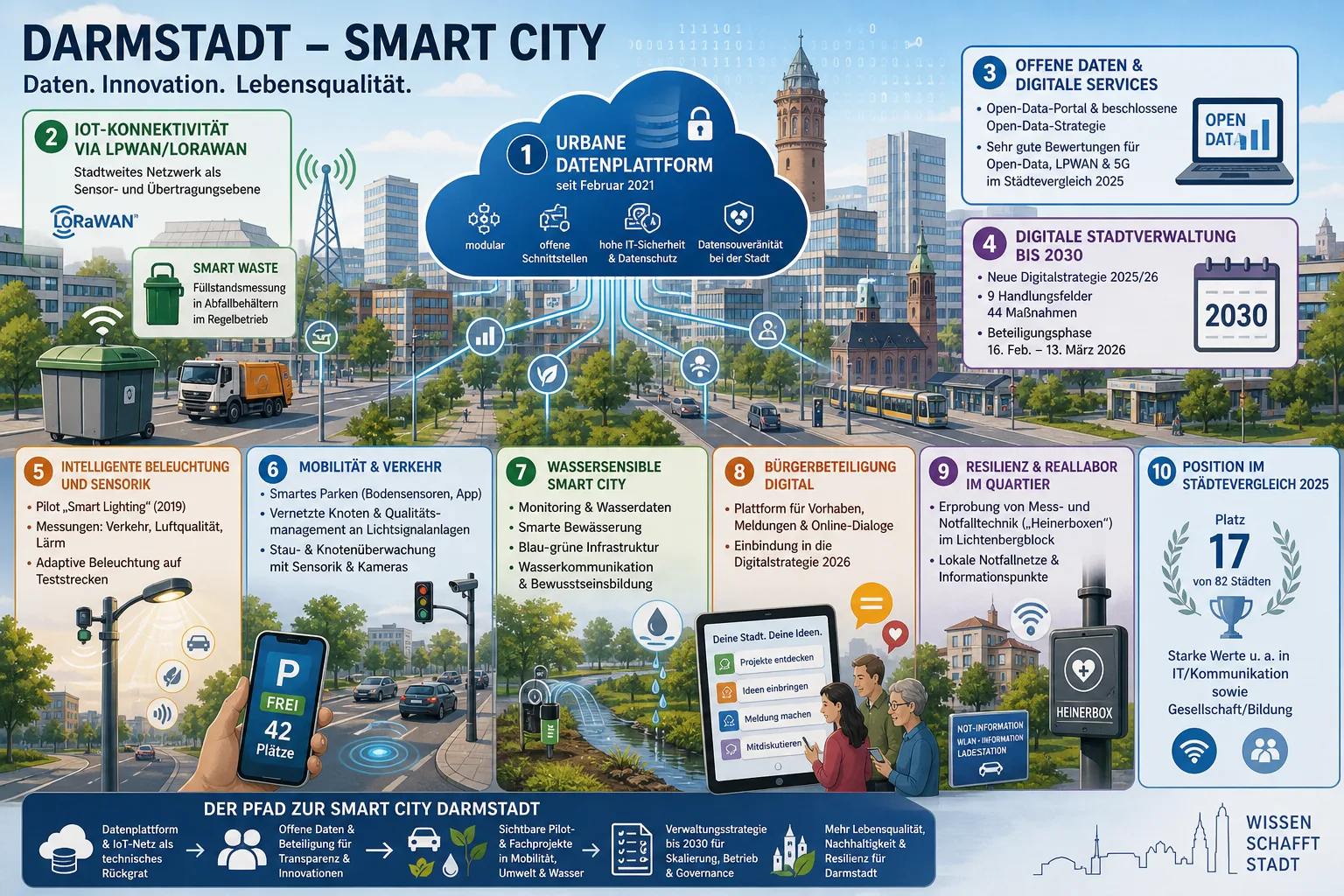
What happens when streetlights in the future not only illuminate but also measure environmental values, record traffic flows, and support crisis communication in emergencies? And how does a city change when waste bins proactively report when they need to be emptied—while an urban data platform securely consolidates data in the background and makes it usable for administration, research, and new services?
In Darmstadt, smart city development in the coming years will be primarily characterized by scaling: individual digital building blocks are to become reliably operated, data protection-compliant services that measurably help in everyday life—in mobility, environment, administration, resilience, and quality of life.
Digital Foundation: Urban Data Platform as Backbone
A central next step in Darmstadt’s smart city roadmap is the further expansion of an urban data platform. In the coming years, it is to become the hub through which data from various areas is centrally consolidated—for example, from mobility, environment, municipal infrastructure, and (where appropriate) from municipal holdings.
What the Platform Should Achieve in the Future
- Integration: Data sources are connected via standardized interfaces so that new applications can be gradually added.
- Governance: Role and rights concepts define who may input, view, export, or publish data.
- Transparency: For public datasets, metadata (origin, timeliness, quality) should be clearly documented.
- Analysis & Visualization: Dashboards and situational pictures can support decisions—for example, in traffic management, climate adaptation, or deployment planning.
Why Modularity Is Important
Municipal IT landscapes change slowly, but smart city use cases change quickly. A modular architecture (instead of a monolithic overall system) is intended to enable Darmstadt to add new sensors, new specialist procedures, or new analyses without having to rebuild the entire system each time.
IoT Network & LoRaWAN: The “Senses” of the Smart City
In the coming years, Darmstadt will be able to scale smart city functions especially where reliable, energy-efficient sensors make sense. For such use cases (small amounts of data, long battery life, large range), LPWAN/LoRaWAN is particularly suitable.
Typical Application Areas Darmstadt Can Expand
- Waste & City Cleanliness: Fill level or condition reports can make routes more demand-oriented and reduce overflows.
- Environmental Monitoring: Measurement points for temperature, humidity, or noise can make hotspots visible and help prioritize measures.
- Water & Heavy Rain: Water level or precipitation data can support early warning systems when coupled with clear thresholds and deployment processes.
- Infrastructure Condition: Sensors can report operating states (e.g., on pumps, control cabinets, systems) and make maintenance more plannable.
Decisive for acceptance will be that Darmstadt defines measurable goals (e.g., fewer empty runs, faster troubleshooting, fewer disruptions in public spaces) and regularly makes the results publicly traceable.
Open Data & Digital Services: Administration of the Future
Smart City becomes tangible for citizens and businesses especially when digital offerings actually simplify administrative processes. For Darmstadt, the coming years will therefore focus on two parallel developments: Open Data and end-to-end digital services.
Open Data: Transparency with a Quality Standard
When Darmstadt provides open datasets, for users it is less about the quantity and more about quality: timeliness, clear licenses, understandable metadata, and stable interfaces. This way, research, civil society, and businesses can translate data into applications—such as visualizations, information services, or analyses for neighborhoods.
Digital Administration: Fewer Media Breaks, Better Traceability
For the years up to 2030, there is a clear trend for municipalities in Germany: administrative services should become more digitally available and processes should run with fewer media breaks. Within this framework, Darmstadt can in particular:
- Design online applications so that they work well on mobile devices (accessibility, clear language, interim saving).
- Create status information so that applicants can track the processing status.
- Digitize internal processes so that processing times decrease and sources of error (e.g., duplicate entries) are reduced.
The effect is particularly significant for local businesses when frequent procedures—such as permits, notifications, or information—become more plannable and transparent.
Smart Lighting, Mobility, Water: Where Changes Become Tangible
In the coming years, Darmstadt will be able to make smart city technology especially tangible where it directly impacts public spaces. Three areas are particularly typical for this: lighting, mobility, and water-sensitive urban development.
Intelligent Lighting: Safety, Energy Efficiency, Lower Light Emissions
Smart lighting will likely focus on two combined goals in the future: demand-oriented dimming (saving energy) and situation-adapted brightness (increasing safety). It is important that rules are transparent (when is dimming applied and how?) and that operating and maintenance processes function reliably so that disruptions are quickly resolved.
Intelligent Mobility: Less Search Traffic, Better Traffic Flow
For Darmstadt, in the coming years, data-based measures that do not require major intrusions into privacy are particularly plausible—for example:
- Parking Space Information (occupancy as aggregate data) to reduce search traffic.
- Quality Measurement at Intersections (e.g., congestion indicators) to plan controls and measures more evidence-based.
- Public Transport Prioritization where it demonstrably improves punctuality and strengthens the environmental alliance.
So that such systems do not remain mere “technology demos,” Darmstadt will need clear success criteria, for example: average search time, travel time stability, congestion frequency, or punctuality indicators (each transparently defined).
Water-Sensitive Smart City: Resilience Against Heat and Heavy Rain
Climate adaptation is a smart city topic when data helps to implement measures in a targeted and effective way. In Darmstadt, the next development step could be to systematically connect measurement data (e.g., soil moisture, precipitation, water level) with measure control—for example, in irrigation, green space maintenance, or early warning and deployment processes.
The added value arises when data-based decisions are traceable: Where are heat islands? Where is the flood risk increased? Which locations benefit most from blue-green infrastructure? This way, Darmstadt can prioritize investments and compare impact over time.
Participation & Living Labs: Innovation in the Neighborhood
Smart City in Darmstadt will only work sustainably in the coming years if people support it. Therefore, the expansion of digital participation and local test spaces (living labs) will remain key.
Digital Participation: Understandable, Early, Effective
For participation to be more than a formality, Darmstadt should design participation formats so that results are visibly fed back: What was contributed, what will be implemented, what not—and why? Especially with smart city technology (sensors, data platform, new services), this traceability strengthens acceptance and prevents misunderstandings.
Living Labs: Testing Under Everyday Conditions
New solutions can be tested under real conditions in neighborhoods: Which sensor locations make sense? Which data is helpful—and which only creates effort? How do residents react? Living labs will be particularly valuable in the coming years because they help test technology, operations, and governance together before a citywide rollout.
Resilience: Technology That Helps in Everyday Life and Supports in Crises
A forward-looking smart city approach is to plan infrastructure so that it is “doubly” useful: In everyday life, it supports routine processes (e.g., environmental monitoring, information services); in exceptional situations, it can strengthen communication and situational functions. For Darmstadt, it will be crucial that emergency concepts not only exist technically but are also practiced and updated organizationally.
Outlook 2026–2030: What Will Be Decisive
Whether Darmstadt will function noticeably better as a smart city by 2030 will depend less on individual flagship projects than on consistent implementation. Five factors are likely to make the difference:
- Operation Instead of Pilot: Projects must move from the test phase to reliable operating models (responsibilities, service levels, maintenance).
- Data Governance: Clear rules on data quality, access rights, deletion periods, anonymization, and publication.
- Security & Data Protection: Protection needs analyses, technical and organizational measures, transparent communication.
- Measurable Impact: Before-and-after comparisons with clear, publicly traceable indicators.
- Cooperation: Collaboration between administration, science, municipal economy, and civil society across standards and interfaces.
This is how Darmstadt becomes a smart city: not through “magical” technology, but through a systematic expansion of digital foundations, responsible data use, and services that save time in everyday life, increase safety, and conserve resources.