
Sabaisplatz 1, Darmstadt-Ost
Sabaisplatz 1, 64287 Darmstadt, Germany
Exhibition Building (Olbrich, 1905 - 1908) | Art Nouveau & UNESCO
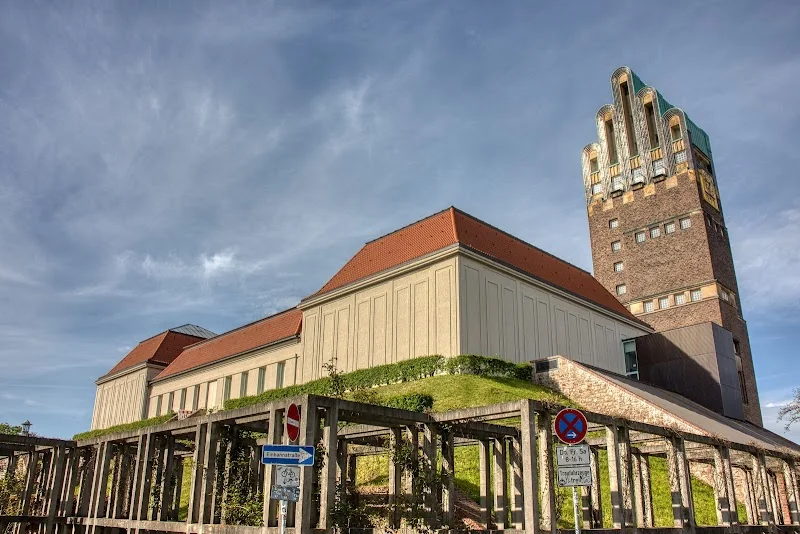
On the highest elevation near the city center of Darmstadt stands an ensemble that condenses the idea of early modernity like few places in Europe: the Mathildenhöhe. Its centerpiece is the exhibition building by Joseph Maria Olbrich, a horizontally structured building with a characteristic, asymmetrical facade design and a wide terrace over climbing pergolas. Built in 1907/08 on the massive foundation of a water reservoir completed in 1880, the exhibition hall, together with the adjacent wedding tower, forms a striking contrast of surfaces, lines, and plastic force. Since 2021, the Mathildenhöhe has been recognized as a UNESCO World Heritage Site – an award that honors the artistic, architectural, and urban significance of the entire ensemble. After a comprehensive restoration and energy renovation, which has made the halls fit for contemporary exhibition operations from 2012 to 2024, the building is preparing for its reopening on June 7, 2026. Visitors to the Mathildenhöhe discover not just a building, but a multifaceted cultural monument where Art Nouveau design language, technical engineering, and current exhibition practices come together.
Olbrich Art Nouveau: Architecture and History of the Exhibition Building
The exhibition building bears the signature of architect Joseph Maria Olbrich, who, as a co-founder of the Vienna Secession and a leading figure of the Darmstadt Artists' Colony, pursued the idea of a total work of art across architecture, craft, and design. The construction phase extends from 1905 to 1908; in the years 1907/08, the hall was built at the highest point of the Mathildenhöhe above the already constructed water reservoir from 1880. Its materiality and composition are exemplary of the reforming spirit around 1900: a volume made of reinforced concrete, clad in light gravel plaster, consciously oriented horizontally – as a “resting” response to the vertically rising, dark brick wedding tower to the north. The asymmetry of the overall design is intentional: a side-set entrance projection with a tent roof and the southern stair pavilion accentuate the building, while the large terrace serves as an entrance and viewpoint. The surrounding columns made of cast concrete, which Olbrich had planted with vines and roses, lead the topography into architectural order – a stepped transition from the rising terrain to the higher plateau of the exhibition halls. At the foot of the stairs, a fountain house designed by Olbrich, covered with copper, welcomes visitors; on the first landing, a small pavilion, supported by granite columns, offers a view over the southern and western area of the artists' colony. Here, one can also find the famous mosaic field with the motto of Grand Duke Ernst Ludwig: “Have respect for the old and courage to dare the new; remain true to your own nature and true to the people you love.” Thus, the program and pathos of the reform movement are condensed in stone, concrete, and ornament. The east side of the halls was altered in the 1970s during restoration work; a previously continuous row of windows was closed between 1974 and 1976. The rear row of pergolas has been completely reconstructed since 2014. Also in the 1970s, extensions for workshops and storage rooms were created, connecting the exhibition building with the wedding tower. Since its opening in 1908, the building has served various exhibitions, public events, and cultural conferences. To ensure this is achieved under today's conservation and energy requirements, the halls were energetically upgraded from 2012 to 2024 according to monument preservation standards – a prerequisite for enabling large-format, technically demanding presentations of contemporary art as well as sensitive exhibitions on the environment of the artists' colony.
Exhibitions around 1900 and today: Programs and Special Features
The exhibition hall was realized in 1908 together with the wedding tower for the “Hessian State Exhibition for Free and Applied Arts” – a programmatic double building for art, craft, and the idea of a newly designed living environment. Here, the Darmstadt Artists' Colony, around Grand Duke Ernst Ludwig, Olbrich, and other protagonists, presented works that were meant to bring “art and life” together. This exhibition profile – the retrospective look at the productive reform era around 1900 and the dialogue with the present – shapes the use to this day. The house hosts outstanding special exhibitions: international contemporary art alongside exhibitions on art and culture around 1900. The museum's operation thus connects to the historical dual focus that was already effective around 1900: the promotion of a new design language in the spirit of the Vienna Secession and the British Arts and Crafts movement, as well as its translation into modern living spaces. After the multi-year renovation phase, the hall will reopen on June 7, 2026, with “Nevin Aladağ – Raise the Roof.” This marks the programmatic return to large-format, installative positions that relate space, sound, ornament, and movement – keywords that naturally arise at this location with its rich ornamentation and architectural rhythm. Beyond the individual changing exhibitions, the hall convinces as a learning and experiential space: right in the World Heritage ensemble – flanked by the Russian Chapel, Ernst Ludwig House, and the artists' houses – it intertwines urban space, garden art, and museum operations. Those visiting the exhibition also experience paths and sightlines: the wide outdoor staircase, the terrace, the pergolas with vines and roses, the stone support walls with mosaic niches by Albin Müller (1914). This spatial dramaturgy is more than a backdrop; it is part of the curatorial toolbox that productively makes the interplay of inside and outside, daylight and sequence of spaces. Thus, one can exemplarily trace at the exhibition building how around 1900 animated surfaces, clear volumes, and landscape architectural settings were brought together into a sensual whole – and how contemporary exhibition practices respectfully update this heritage.
Directions to Mathildenhöhe and Parking at the Exhibition Building
The Mathildenhöhe is located east of the Darmstadt city center and is easily accessible by public transport as well as on foot or by bicycle. From Darmstadt Central Station, bus lines F/FM head towards Oberwaldhaus/Urberach to the stop “Lucasweg/Hochzeitsturm.” From there, it is about 200 meters on foot to the ensemble – a short ascent that leads directly to the plateau of the Mathildenhöhe. Those arriving at the Darmstadt-Ost stop can reach the Mathildenhöhe in about five to ten minutes on foot. For those arriving by car, there is a clear visitor rule: there are no parking facilities available at the Mathildenhöhe itself. Several parking garages and lots within walking distance are recommended, catering to different needs. The darmstadtium parking garage on Alexanderstraße is particularly convenient; from there, one can reach the Mathildenhöhe in about 800 meters via the Erich-Ollenhauer promenade. Also recommended are the Alice Hospital parking garage (Dieburger Straße) and the Justus-Liebig Garage at Holzstraße 6 (each about 1 kilometer away). Those parking in the Friedensplatz area can use the Schlossgarage/Karolinenplatz (Friedensplatz 4) and reach the Mathildenhöhe after about a kilometer walk. Another option is parking at the Jugendstilbad (Mercksplatz 1), which offers both car spaces and two designated bus spaces; the walk to the Mathildenhöhe is about 800 meters. For visitors arriving by coach, stopping at the Mathildenhöhe is only permitted for boarding and alighting. Long-term parking for buses is available at Rosenhöhe in Wolfskehlstraße (address: Bernhard-Sälzer-Platz), from where it is about 500 meters on foot to the Mathildenhöhe. From the direction of Frankfurt am Main Airport, the drive by car via the A5 takes about 30 minutes; alternatively, the AirLiner bus runs directly from the airport to Darmstadt Central Station. For a comfortable and sustainable arrival, one can combine public transport with a short walk through one of the region's most beautiful cultural districts – the path leads past notable stations such as the Russian Chapel and the Plane Tree Grove and already offers impressive perspectives on the tower, terraces, and pergolas before the exhibition visit.
UNESCO World Heritage: Why the Ensemble of Exhibition Hall and Wedding Tower is Unique
Since July 24, 2021, the Mathildenhöhe Darmstadt has been part of the UNESCO World Heritage list. This recognition pertains to the extraordinary testimony of an early modernity that newly connected architecture, art, craft, urban and landscape design. The UNESCO justification emphasizes that the Mathildenhöhe became a central laboratory for modern life concepts between 1901 and 1914 – from the artistic avant-garde to applied arts to the development of new living and working environments. The exhibition building plays a key role in this context: conceived as an urban exhibition hall for the “Hessian State Exhibition for Free and Applied Arts” of 1908 and realized together with the wedding tower, it materializes the idea of a publicly accessible art forum. The architectural disposition – flat, horizontal, asymmetrical, rich in ornamental details – sets a visual counterpoint to the tower-like wedding tower made of dark brick. Together, both buildings define the “city crown” of Darmstadt and frame a sequence of public spaces: outdoor staircase, terraces, pergolas, and squares. In addition to the exhibition hall and the tower, the World Heritage site includes other notable buildings and designed open spaces – such as the Ernst Ludwig House (now Museum of the Artists' Colony), the artists' houses, and landscape architectural settings that rhythmize the entire ensemble. This connection makes it clear why the place is more than just the sum of its parts: it is a documented experimental field of modernity, whose signal effect reached beyond Hesse. The World Heritage recognition is also a commitment: it demands careful maintenance, architectural restraint, and intelligent mediation to ensure that historical substance, spatial impact, and contemporary use remain in balance over the long term. Today, those walking through the halls experience not only exhibits but an environment where the history of modernity is literally present in every joint – from the gravel plaster to the mosaic, from the cast concrete support to the clear geometry of the facades.
Practical Information: Opening Hours, Tickets, and Accessibility
During the exhibition periods, the exhibition building is open from Tuesday to Sunday from 11:00 AM to 6:00 PM; it is closed on Mondays. The reopening after the renovation is scheduled for June 7, 2026, starting with the exhibition “Nevin Aladağ – Raise the Roof.” The regular admission to the exhibition building is 10 euros, reduced 8 euros (e.g., for students, trainees, and people with disabilities upon proof). From June 7, 2026, a combination ticket for the exhibition building and the Museum of the Artists' Colony will be available for 12 euros (reduced 10 euros); this ticket is only available on-site. Particularly attractive for a comprehensive visit is the Mathildenhöhe Card: during exhibitions, it costs 15 euros and includes admission to the Museum of the Artists' Colony, the reopened exhibition building, and the wedding tower; it also includes 24 hours of free public transport in fare zone 4000 within Darmstadt. A time slot reservation is currently not required; tickets can be conveniently purchased online in advance. For those requiring accessibility, there is a barrier-free access at the exhibition building on the south side; two designated disabled parking spaces are marked at Olbrichweg 10 (in front of the Hochschule Darmstadt), which particularly facilitate the level access to the barrier-free entrance of the Museum of the Artists' Colony. Due to the limited parking situation, arriving by public transport is generally recommended. For visitors on-site, the Mathildenhöhe information point at Olbrichweg provides orientation, guided tours, and ticket information on weekends (Saturdays and Sundays 10 AM to 5 PM). Holiday regulations may vary; therefore, it is worth taking a look at the current notices from the institution in advance. Equipped this way, the visit can be well planned – whether one is specifically targeting an exhibition or wants to explore the World Heritage ensemble with the tower, squares, and gardens in an extensive tour.
From Water Reservoir to Museum Location: Technical Monument Under the Hall
A unique feature of the exhibition building is its substructure: the former water high reservoir of the city of Darmstadt, an engineering marvel from 1880. In times of rapid population growth, the city created a modern, efficient water supply; the planning and execution were the responsibility of engineer Otto Lueger, who specialized in water construction. The reservoir remained in operation until 1994; today it is considered a technical monument. The overlay of infrastructure and cultural house is anything but coincidental: the choice of location – the highest elevation close to the city – ensured technical efficiency while also providing a representative stage for the reform project of the artists' colony. Those accessing the exhibition building from the south side feel this layering of functions and epochs. The retaining walls made of rubble stone not only support the plateau of the exhibition halls but are also part of a deliberately composed landscape that was enhanced in 1914 by Albin Müller with a seating niche and mosaic. The reservoir itself is accessed via valve chambers and stairs; a cast-iron spiral staircase leads to the historical functional rooms. Although these technical areas are not part of the regular exhibition tour, they shape the aura of the place: the knowledge of the infrastructure enhances the experience of the hall above – as if each exhibition were also a tribute to the city engineering that supports it. This connection of engineering, urban development, and artistic avant-garde is rare internationally and makes the Mathildenhöhe an exemplary place of learning. The recent renovation work on the exhibition hall therefore aimed not only at energy efficiency and climate stability for the art but also at the long-term preservation of this technical heritage. The fact that historical substance and current use can coexist under World Heritage regulations is one of the most remarkable achievements of the planners in recent years. Visitors may not see this directly – but they benefit from a building that masters the balance of monument preservation, sustainability, and contemporary museum logistics.
Service for the Visit: Paths, Tips, and Experiences at Mathildenhöhe
An ideal tour begins at the foot of the large outdoor staircase: from here, sightlines open up to the “Wedding Tower” and the hall, whose bright plaster surfaces shimmer in the daylight. Once at the terrace, one should walk around the row of pergolas – the gentle terracing that Olbrich envisioned with planting of vines and roses is now once again fully experienced and connects architecture and garden art. If one takes their time, the fine details come into focus: the proportions of the entrance projection with a tent roof, the connection of the southern stair pavilion, the graphic strictness of the closed east facade, which was revised in the 1970s. Photography lovers will find different moods in the changing times of day; in the late afternoon, the bright gravel plaster glows warmly, while the dark bricks of the tower contrast. Families are best advised to plan a combination of exhibition and stroll through the ensemble: the Russian Chapel, the Ernst Ludwig House (now Museum of the Artists' Colony), and the artists' houses are close together and make the cultural walk enjoyable. For all who wish to prepare their visit, it is advisable to arrive by bus F/FM to “Lucasweg/Hochzeitsturm” or by car to one of the mentioned parking garages (darmstadtium, Alice Hospital, Justus-Liebig-Garage, Schlossgarage/Karolinenplatz, Jugendstilbad). Those needing barrier-free access can use the side entrance on the south side of the hall; two disabled parking spaces are located at Olbrichweg 10 near the barrier-free entrance of the Museum of the Artists' Colony. Tickets can be easily secured online; time slot bookings are not necessary. For comprehensive experiences, the Mathildenhöhe Card (15 euros during exhibitions) is worthwhile, as it includes museum admissions and 24 hours of public transport in the city area – ideal for connecting the visit with other cultural sites in Darmstadt. And one more tip: since the exhibition building reopens on June 7, 2026, it is worth checking the event program around the opening – the combination of international contemporary art and the historical site promises strong contrasts that have always shaped the DNA of the Mathildenhöhe.
Sources:
Show moreShow less
Exhibition Building (Olbrich, 1905 - 1908) | Art Nouveau & UNESCO
On the highest elevation near the city center of Darmstadt stands an ensemble that condenses the idea of early modernity like few places in Europe: the Mathildenhöhe. Its centerpiece is the exhibition building by Joseph Maria Olbrich, a horizontally structured building with a characteristic, asymmetrical facade design and a wide terrace over climbing pergolas. Built in 1907/08 on the massive foundation of a water reservoir completed in 1880, the exhibition hall, together with the adjacent wedding tower, forms a striking contrast of surfaces, lines, and plastic force. Since 2021, the Mathildenhöhe has been recognized as a UNESCO World Heritage Site – an award that honors the artistic, architectural, and urban significance of the entire ensemble. After a comprehensive restoration and energy renovation, which has made the halls fit for contemporary exhibition operations from 2012 to 2024, the building is preparing for its reopening on June 7, 2026. Visitors to the Mathildenhöhe discover not just a building, but a multifaceted cultural monument where Art Nouveau design language, technical engineering, and current exhibition practices come together.
Olbrich Art Nouveau: Architecture and History of the Exhibition Building
The exhibition building bears the signature of architect Joseph Maria Olbrich, who, as a co-founder of the Vienna Secession and a leading figure of the Darmstadt Artists' Colony, pursued the idea of a total work of art across architecture, craft, and design. The construction phase extends from 1905 to 1908; in the years 1907/08, the hall was built at the highest point of the Mathildenhöhe above the already constructed water reservoir from 1880. Its materiality and composition are exemplary of the reforming spirit around 1900: a volume made of reinforced concrete, clad in light gravel plaster, consciously oriented horizontally – as a “resting” response to the vertically rising, dark brick wedding tower to the north. The asymmetry of the overall design is intentional: a side-set entrance projection with a tent roof and the southern stair pavilion accentuate the building, while the large terrace serves as an entrance and viewpoint. The surrounding columns made of cast concrete, which Olbrich had planted with vines and roses, lead the topography into architectural order – a stepped transition from the rising terrain to the higher plateau of the exhibition halls. At the foot of the stairs, a fountain house designed by Olbrich, covered with copper, welcomes visitors; on the first landing, a small pavilion, supported by granite columns, offers a view over the southern and western area of the artists' colony. Here, one can also find the famous mosaic field with the motto of Grand Duke Ernst Ludwig: “Have respect for the old and courage to dare the new; remain true to your own nature and true to the people you love.” Thus, the program and pathos of the reform movement are condensed in stone, concrete, and ornament. The east side of the halls was altered in the 1970s during restoration work; a previously continuous row of windows was closed between 1974 and 1976. The rear row of pergolas has been completely reconstructed since 2014. Also in the 1970s, extensions for workshops and storage rooms were created, connecting the exhibition building with the wedding tower. Since its opening in 1908, the building has served various exhibitions, public events, and cultural conferences. To ensure this is achieved under today's conservation and energy requirements, the halls were energetically upgraded from 2012 to 2024 according to monument preservation standards – a prerequisite for enabling large-format, technically demanding presentations of contemporary art as well as sensitive exhibitions on the environment of the artists' colony.
Exhibitions around 1900 and today: Programs and Special Features
The exhibition hall was realized in 1908 together with the wedding tower for the “Hessian State Exhibition for Free and Applied Arts” – a programmatic double building for art, craft, and the idea of a newly designed living environment. Here, the Darmstadt Artists' Colony, around Grand Duke Ernst Ludwig, Olbrich, and other protagonists, presented works that were meant to bring “art and life” together. This exhibition profile – the retrospective look at the productive reform era around 1900 and the dialogue with the present – shapes the use to this day. The house hosts outstanding special exhibitions: international contemporary art alongside exhibitions on art and culture around 1900. The museum's operation thus connects to the historical dual focus that was already effective around 1900: the promotion of a new design language in the spirit of the Vienna Secession and the British Arts and Crafts movement, as well as its translation into modern living spaces. After the multi-year renovation phase, the hall will reopen on June 7, 2026, with “Nevin Aladağ – Raise the Roof.” This marks the programmatic return to large-format, installative positions that relate space, sound, ornament, and movement – keywords that naturally arise at this location with its rich ornamentation and architectural rhythm. Beyond the individual changing exhibitions, the hall convinces as a learning and experiential space: right in the World Heritage ensemble – flanked by the Russian Chapel, Ernst Ludwig House, and the artists' houses – it intertwines urban space, garden art, and museum operations. Those visiting the exhibition also experience paths and sightlines: the wide outdoor staircase, the terrace, the pergolas with vines and roses, the stone support walls with mosaic niches by Albin Müller (1914). This spatial dramaturgy is more than a backdrop; it is part of the curatorial toolbox that productively makes the interplay of inside and outside, daylight and sequence of spaces. Thus, one can exemplarily trace at the exhibition building how around 1900 animated surfaces, clear volumes, and landscape architectural settings were brought together into a sensual whole – and how contemporary exhibition practices respectfully update this heritage.
Directions to Mathildenhöhe and Parking at the Exhibition Building
The Mathildenhöhe is located east of the Darmstadt city center and is easily accessible by public transport as well as on foot or by bicycle. From Darmstadt Central Station, bus lines F/FM head towards Oberwaldhaus/Urberach to the stop “Lucasweg/Hochzeitsturm.” From there, it is about 200 meters on foot to the ensemble – a short ascent that leads directly to the plateau of the Mathildenhöhe. Those arriving at the Darmstadt-Ost stop can reach the Mathildenhöhe in about five to ten minutes on foot. For those arriving by car, there is a clear visitor rule: there are no parking facilities available at the Mathildenhöhe itself. Several parking garages and lots within walking distance are recommended, catering to different needs. The darmstadtium parking garage on Alexanderstraße is particularly convenient; from there, one can reach the Mathildenhöhe in about 800 meters via the Erich-Ollenhauer promenade. Also recommended are the Alice Hospital parking garage (Dieburger Straße) and the Justus-Liebig Garage at Holzstraße 6 (each about 1 kilometer away). Those parking in the Friedensplatz area can use the Schlossgarage/Karolinenplatz (Friedensplatz 4) and reach the Mathildenhöhe after about a kilometer walk. Another option is parking at the Jugendstilbad (Mercksplatz 1), which offers both car spaces and two designated bus spaces; the walk to the Mathildenhöhe is about 800 meters. For visitors arriving by coach, stopping at the Mathildenhöhe is only permitted for boarding and alighting. Long-term parking for buses is available at Rosenhöhe in Wolfskehlstraße (address: Bernhard-Sälzer-Platz), from where it is about 500 meters on foot to the Mathildenhöhe. From the direction of Frankfurt am Main Airport, the drive by car via the A5 takes about 30 minutes; alternatively, the AirLiner bus runs directly from the airport to Darmstadt Central Station. For a comfortable and sustainable arrival, one can combine public transport with a short walk through one of the region's most beautiful cultural districts – the path leads past notable stations such as the Russian Chapel and the Plane Tree Grove and already offers impressive perspectives on the tower, terraces, and pergolas before the exhibition visit.
UNESCO World Heritage: Why the Ensemble of Exhibition Hall and Wedding Tower is Unique
Since July 24, 2021, the Mathildenhöhe Darmstadt has been part of the UNESCO World Heritage list. This recognition pertains to the extraordinary testimony of an early modernity that newly connected architecture, art, craft, urban and landscape design. The UNESCO justification emphasizes that the Mathildenhöhe became a central laboratory for modern life concepts between 1901 and 1914 – from the artistic avant-garde to applied arts to the development of new living and working environments. The exhibition building plays a key role in this context: conceived as an urban exhibition hall for the “Hessian State Exhibition for Free and Applied Arts” of 1908 and realized together with the wedding tower, it materializes the idea of a publicly accessible art forum. The architectural disposition – flat, horizontal, asymmetrical, rich in ornamental details – sets a visual counterpoint to the tower-like wedding tower made of dark brick. Together, both buildings define the “city crown” of Darmstadt and frame a sequence of public spaces: outdoor staircase, terraces, pergolas, and squares. In addition to the exhibition hall and the tower, the World Heritage site includes other notable buildings and designed open spaces – such as the Ernst Ludwig House (now Museum of the Artists' Colony), the artists' houses, and landscape architectural settings that rhythmize the entire ensemble. This connection makes it clear why the place is more than just the sum of its parts: it is a documented experimental field of modernity, whose signal effect reached beyond Hesse. The World Heritage recognition is also a commitment: it demands careful maintenance, architectural restraint, and intelligent mediation to ensure that historical substance, spatial impact, and contemporary use remain in balance over the long term. Today, those walking through the halls experience not only exhibits but an environment where the history of modernity is literally present in every joint – from the gravel plaster to the mosaic, from the cast concrete support to the clear geometry of the facades.
Practical Information: Opening Hours, Tickets, and Accessibility
During the exhibition periods, the exhibition building is open from Tuesday to Sunday from 11:00 AM to 6:00 PM; it is closed on Mondays. The reopening after the renovation is scheduled for June 7, 2026, starting with the exhibition “Nevin Aladağ – Raise the Roof.” The regular admission to the exhibition building is 10 euros, reduced 8 euros (e.g., for students, trainees, and people with disabilities upon proof). From June 7, 2026, a combination ticket for the exhibition building and the Museum of the Artists' Colony will be available for 12 euros (reduced 10 euros); this ticket is only available on-site. Particularly attractive for a comprehensive visit is the Mathildenhöhe Card: during exhibitions, it costs 15 euros and includes admission to the Museum of the Artists' Colony, the reopened exhibition building, and the wedding tower; it also includes 24 hours of free public transport in fare zone 4000 within Darmstadt. A time slot reservation is currently not required; tickets can be conveniently purchased online in advance. For those requiring accessibility, there is a barrier-free access at the exhibition building on the south side; two designated disabled parking spaces are marked at Olbrichweg 10 (in front of the Hochschule Darmstadt), which particularly facilitate the level access to the barrier-free entrance of the Museum of the Artists' Colony. Due to the limited parking situation, arriving by public transport is generally recommended. For visitors on-site, the Mathildenhöhe information point at Olbrichweg provides orientation, guided tours, and ticket information on weekends (Saturdays and Sundays 10 AM to 5 PM). Holiday regulations may vary; therefore, it is worth taking a look at the current notices from the institution in advance. Equipped this way, the visit can be well planned – whether one is specifically targeting an exhibition or wants to explore the World Heritage ensemble with the tower, squares, and gardens in an extensive tour.
From Water Reservoir to Museum Location: Technical Monument Under the Hall
A unique feature of the exhibition building is its substructure: the former water high reservoir of the city of Darmstadt, an engineering marvel from 1880. In times of rapid population growth, the city created a modern, efficient water supply; the planning and execution were the responsibility of engineer Otto Lueger, who specialized in water construction. The reservoir remained in operation until 1994; today it is considered a technical monument. The overlay of infrastructure and cultural house is anything but coincidental: the choice of location – the highest elevation close to the city – ensured technical efficiency while also providing a representative stage for the reform project of the artists' colony. Those accessing the exhibition building from the south side feel this layering of functions and epochs. The retaining walls made of rubble stone not only support the plateau of the exhibition halls but are also part of a deliberately composed landscape that was enhanced in 1914 by Albin Müller with a seating niche and mosaic. The reservoir itself is accessed via valve chambers and stairs; a cast-iron spiral staircase leads to the historical functional rooms. Although these technical areas are not part of the regular exhibition tour, they shape the aura of the place: the knowledge of the infrastructure enhances the experience of the hall above – as if each exhibition were also a tribute to the city engineering that supports it. This connection of engineering, urban development, and artistic avant-garde is rare internationally and makes the Mathildenhöhe an exemplary place of learning. The recent renovation work on the exhibition hall therefore aimed not only at energy efficiency and climate stability for the art but also at the long-term preservation of this technical heritage. The fact that historical substance and current use can coexist under World Heritage regulations is one of the most remarkable achievements of the planners in recent years. Visitors may not see this directly – but they benefit from a building that masters the balance of monument preservation, sustainability, and contemporary museum logistics.
Service for the Visit: Paths, Tips, and Experiences at Mathildenhöhe
An ideal tour begins at the foot of the large outdoor staircase: from here, sightlines open up to the “Wedding Tower” and the hall, whose bright plaster surfaces shimmer in the daylight. Once at the terrace, one should walk around the row of pergolas – the gentle terracing that Olbrich envisioned with planting of vines and roses is now once again fully experienced and connects architecture and garden art. If one takes their time, the fine details come into focus: the proportions of the entrance projection with a tent roof, the connection of the southern stair pavilion, the graphic strictness of the closed east facade, which was revised in the 1970s. Photography lovers will find different moods in the changing times of day; in the late afternoon, the bright gravel plaster glows warmly, while the dark bricks of the tower contrast. Families are best advised to plan a combination of exhibition and stroll through the ensemble: the Russian Chapel, the Ernst Ludwig House (now Museum of the Artists' Colony), and the artists' houses are close together and make the cultural walk enjoyable. For all who wish to prepare their visit, it is advisable to arrive by bus F/FM to “Lucasweg/Hochzeitsturm” or by car to one of the mentioned parking garages (darmstadtium, Alice Hospital, Justus-Liebig-Garage, Schlossgarage/Karolinenplatz, Jugendstilbad). Those needing barrier-free access can use the side entrance on the south side of the hall; two disabled parking spaces are located at Olbrichweg 10 near the barrier-free entrance of the Museum of the Artists' Colony. Tickets can be easily secured online; time slot bookings are not necessary. For comprehensive experiences, the Mathildenhöhe Card (15 euros during exhibitions) is worthwhile, as it includes museum admissions and 24 hours of public transport in the city area – ideal for connecting the visit with other cultural sites in Darmstadt. And one more tip: since the exhibition building reopens on June 7, 2026, it is worth checking the event program around the opening – the combination of international contemporary art and the historical site promises strong contrasts that have always shaped the DNA of the Mathildenhöhe.
Sources:
Exhibition Building (Olbrich, 1905 - 1908) | Art Nouveau & UNESCO
On the highest elevation near the city center of Darmstadt stands an ensemble that condenses the idea of early modernity like few places in Europe: the Mathildenhöhe. Its centerpiece is the exhibition building by Joseph Maria Olbrich, a horizontally structured building with a characteristic, asymmetrical facade design and a wide terrace over climbing pergolas. Built in 1907/08 on the massive foundation of a water reservoir completed in 1880, the exhibition hall, together with the adjacent wedding tower, forms a striking contrast of surfaces, lines, and plastic force. Since 2021, the Mathildenhöhe has been recognized as a UNESCO World Heritage Site – an award that honors the artistic, architectural, and urban significance of the entire ensemble. After a comprehensive restoration and energy renovation, which has made the halls fit for contemporary exhibition operations from 2012 to 2024, the building is preparing for its reopening on June 7, 2026. Visitors to the Mathildenhöhe discover not just a building, but a multifaceted cultural monument where Art Nouveau design language, technical engineering, and current exhibition practices come together.
Olbrich Art Nouveau: Architecture and History of the Exhibition Building
The exhibition building bears the signature of architect Joseph Maria Olbrich, who, as a co-founder of the Vienna Secession and a leading figure of the Darmstadt Artists' Colony, pursued the idea of a total work of art across architecture, craft, and design. The construction phase extends from 1905 to 1908; in the years 1907/08, the hall was built at the highest point of the Mathildenhöhe above the already constructed water reservoir from 1880. Its materiality and composition are exemplary of the reforming spirit around 1900: a volume made of reinforced concrete, clad in light gravel plaster, consciously oriented horizontally – as a “resting” response to the vertically rising, dark brick wedding tower to the north. The asymmetry of the overall design is intentional: a side-set entrance projection with a tent roof and the southern stair pavilion accentuate the building, while the large terrace serves as an entrance and viewpoint. The surrounding columns made of cast concrete, which Olbrich had planted with vines and roses, lead the topography into architectural order – a stepped transition from the rising terrain to the higher plateau of the exhibition halls. At the foot of the stairs, a fountain house designed by Olbrich, covered with copper, welcomes visitors; on the first landing, a small pavilion, supported by granite columns, offers a view over the southern and western area of the artists' colony. Here, one can also find the famous mosaic field with the motto of Grand Duke Ernst Ludwig: “Have respect for the old and courage to dare the new; remain true to your own nature and true to the people you love.” Thus, the program and pathos of the reform movement are condensed in stone, concrete, and ornament. The east side of the halls was altered in the 1970s during restoration work; a previously continuous row of windows was closed between 1974 and 1976. The rear row of pergolas has been completely reconstructed since 2014. Also in the 1970s, extensions for workshops and storage rooms were created, connecting the exhibition building with the wedding tower. Since its opening in 1908, the building has served various exhibitions, public events, and cultural conferences. To ensure this is achieved under today's conservation and energy requirements, the halls were energetically upgraded from 2012 to 2024 according to monument preservation standards – a prerequisite for enabling large-format, technically demanding presentations of contemporary art as well as sensitive exhibitions on the environment of the artists' colony.
Exhibitions around 1900 and today: Programs and Special Features
The exhibition hall was realized in 1908 together with the wedding tower for the “Hessian State Exhibition for Free and Applied Arts” – a programmatic double building for art, craft, and the idea of a newly designed living environment. Here, the Darmstadt Artists' Colony, around Grand Duke Ernst Ludwig, Olbrich, and other protagonists, presented works that were meant to bring “art and life” together. This exhibition profile – the retrospective look at the productive reform era around 1900 and the dialogue with the present – shapes the use to this day. The house hosts outstanding special exhibitions: international contemporary art alongside exhibitions on art and culture around 1900. The museum's operation thus connects to the historical dual focus that was already effective around 1900: the promotion of a new design language in the spirit of the Vienna Secession and the British Arts and Crafts movement, as well as its translation into modern living spaces. After the multi-year renovation phase, the hall will reopen on June 7, 2026, with “Nevin Aladağ – Raise the Roof.” This marks the programmatic return to large-format, installative positions that relate space, sound, ornament, and movement – keywords that naturally arise at this location with its rich ornamentation and architectural rhythm. Beyond the individual changing exhibitions, the hall convinces as a learning and experiential space: right in the World Heritage ensemble – flanked by the Russian Chapel, Ernst Ludwig House, and the artists' houses – it intertwines urban space, garden art, and museum operations. Those visiting the exhibition also experience paths and sightlines: the wide outdoor staircase, the terrace, the pergolas with vines and roses, the stone support walls with mosaic niches by Albin Müller (1914). This spatial dramaturgy is more than a backdrop; it is part of the curatorial toolbox that productively makes the interplay of inside and outside, daylight and sequence of spaces. Thus, one can exemplarily trace at the exhibition building how around 1900 animated surfaces, clear volumes, and landscape architectural settings were brought together into a sensual whole – and how contemporary exhibition practices respectfully update this heritage.
Directions to Mathildenhöhe and Parking at the Exhibition Building
The Mathildenhöhe is located east of the Darmstadt city center and is easily accessible by public transport as well as on foot or by bicycle. From Darmstadt Central Station, bus lines F/FM head towards Oberwaldhaus/Urberach to the stop “Lucasweg/Hochzeitsturm.” From there, it is about 200 meters on foot to the ensemble – a short ascent that leads directly to the plateau of the Mathildenhöhe. Those arriving at the Darmstadt-Ost stop can reach the Mathildenhöhe in about five to ten minutes on foot. For those arriving by car, there is a clear visitor rule: there are no parking facilities available at the Mathildenhöhe itself. Several parking garages and lots within walking distance are recommended, catering to different needs. The darmstadtium parking garage on Alexanderstraße is particularly convenient; from there, one can reach the Mathildenhöhe in about 800 meters via the Erich-Ollenhauer promenade. Also recommended are the Alice Hospital parking garage (Dieburger Straße) and the Justus-Liebig Garage at Holzstraße 6 (each about 1 kilometer away). Those parking in the Friedensplatz area can use the Schlossgarage/Karolinenplatz (Friedensplatz 4) and reach the Mathildenhöhe after about a kilometer walk. Another option is parking at the Jugendstilbad (Mercksplatz 1), which offers both car spaces and two designated bus spaces; the walk to the Mathildenhöhe is about 800 meters. For visitors arriving by coach, stopping at the Mathildenhöhe is only permitted for boarding and alighting. Long-term parking for buses is available at Rosenhöhe in Wolfskehlstraße (address: Bernhard-Sälzer-Platz), from where it is about 500 meters on foot to the Mathildenhöhe. From the direction of Frankfurt am Main Airport, the drive by car via the A5 takes about 30 minutes; alternatively, the AirLiner bus runs directly from the airport to Darmstadt Central Station. For a comfortable and sustainable arrival, one can combine public transport with a short walk through one of the region's most beautiful cultural districts – the path leads past notable stations such as the Russian Chapel and the Plane Tree Grove and already offers impressive perspectives on the tower, terraces, and pergolas before the exhibition visit.
UNESCO World Heritage: Why the Ensemble of Exhibition Hall and Wedding Tower is Unique
Since July 24, 2021, the Mathildenhöhe Darmstadt has been part of the UNESCO World Heritage list. This recognition pertains to the extraordinary testimony of an early modernity that newly connected architecture, art, craft, urban and landscape design. The UNESCO justification emphasizes that the Mathildenhöhe became a central laboratory for modern life concepts between 1901 and 1914 – from the artistic avant-garde to applied arts to the development of new living and working environments. The exhibition building plays a key role in this context: conceived as an urban exhibition hall for the “Hessian State Exhibition for Free and Applied Arts” of 1908 and realized together with the wedding tower, it materializes the idea of a publicly accessible art forum. The architectural disposition – flat, horizontal, asymmetrical, rich in ornamental details – sets a visual counterpoint to the tower-like wedding tower made of dark brick. Together, both buildings define the “city crown” of Darmstadt and frame a sequence of public spaces: outdoor staircase, terraces, pergolas, and squares. In addition to the exhibition hall and the tower, the World Heritage site includes other notable buildings and designed open spaces – such as the Ernst Ludwig House (now Museum of the Artists' Colony), the artists' houses, and landscape architectural settings that rhythmize the entire ensemble. This connection makes it clear why the place is more than just the sum of its parts: it is a documented experimental field of modernity, whose signal effect reached beyond Hesse. The World Heritage recognition is also a commitment: it demands careful maintenance, architectural restraint, and intelligent mediation to ensure that historical substance, spatial impact, and contemporary use remain in balance over the long term. Today, those walking through the halls experience not only exhibits but an environment where the history of modernity is literally present in every joint – from the gravel plaster to the mosaic, from the cast concrete support to the clear geometry of the facades.
Practical Information: Opening Hours, Tickets, and Accessibility
During the exhibition periods, the exhibition building is open from Tuesday to Sunday from 11:00 AM to 6:00 PM; it is closed on Mondays. The reopening after the renovation is scheduled for June 7, 2026, starting with the exhibition “Nevin Aladağ – Raise the Roof.” The regular admission to the exhibition building is 10 euros, reduced 8 euros (e.g., for students, trainees, and people with disabilities upon proof). From June 7, 2026, a combination ticket for the exhibition building and the Museum of the Artists' Colony will be available for 12 euros (reduced 10 euros); this ticket is only available on-site. Particularly attractive for a comprehensive visit is the Mathildenhöhe Card: during exhibitions, it costs 15 euros and includes admission to the Museum of the Artists' Colony, the reopened exhibition building, and the wedding tower; it also includes 24 hours of free public transport in fare zone 4000 within Darmstadt. A time slot reservation is currently not required; tickets can be conveniently purchased online in advance. For those requiring accessibility, there is a barrier-free access at the exhibition building on the south side; two designated disabled parking spaces are marked at Olbrichweg 10 (in front of the Hochschule Darmstadt), which particularly facilitate the level access to the barrier-free entrance of the Museum of the Artists' Colony. Due to the limited parking situation, arriving by public transport is generally recommended. For visitors on-site, the Mathildenhöhe information point at Olbrichweg provides orientation, guided tours, and ticket information on weekends (Saturdays and Sundays 10 AM to 5 PM). Holiday regulations may vary; therefore, it is worth taking a look at the current notices from the institution in advance. Equipped this way, the visit can be well planned – whether one is specifically targeting an exhibition or wants to explore the World Heritage ensemble with the tower, squares, and gardens in an extensive tour.
From Water Reservoir to Museum Location: Technical Monument Under the Hall
A unique feature of the exhibition building is its substructure: the former water high reservoir of the city of Darmstadt, an engineering marvel from 1880. In times of rapid population growth, the city created a modern, efficient water supply; the planning and execution were the responsibility of engineer Otto Lueger, who specialized in water construction. The reservoir remained in operation until 1994; today it is considered a technical monument. The overlay of infrastructure and cultural house is anything but coincidental: the choice of location – the highest elevation close to the city – ensured technical efficiency while also providing a representative stage for the reform project of the artists' colony. Those accessing the exhibition building from the south side feel this layering of functions and epochs. The retaining walls made of rubble stone not only support the plateau of the exhibition halls but are also part of a deliberately composed landscape that was enhanced in 1914 by Albin Müller with a seating niche and mosaic. The reservoir itself is accessed via valve chambers and stairs; a cast-iron spiral staircase leads to the historical functional rooms. Although these technical areas are not part of the regular exhibition tour, they shape the aura of the place: the knowledge of the infrastructure enhances the experience of the hall above – as if each exhibition were also a tribute to the city engineering that supports it. This connection of engineering, urban development, and artistic avant-garde is rare internationally and makes the Mathildenhöhe an exemplary place of learning. The recent renovation work on the exhibition hall therefore aimed not only at energy efficiency and climate stability for the art but also at the long-term preservation of this technical heritage. The fact that historical substance and current use can coexist under World Heritage regulations is one of the most remarkable achievements of the planners in recent years. Visitors may not see this directly – but they benefit from a building that masters the balance of monument preservation, sustainability, and contemporary museum logistics.
Service for the Visit: Paths, Tips, and Experiences at Mathildenhöhe
An ideal tour begins at the foot of the large outdoor staircase: from here, sightlines open up to the “Wedding Tower” and the hall, whose bright plaster surfaces shimmer in the daylight. Once at the terrace, one should walk around the row of pergolas – the gentle terracing that Olbrich envisioned with planting of vines and roses is now once again fully experienced and connects architecture and garden art. If one takes their time, the fine details come into focus: the proportions of the entrance projection with a tent roof, the connection of the southern stair pavilion, the graphic strictness of the closed east facade, which was revised in the 1970s. Photography lovers will find different moods in the changing times of day; in the late afternoon, the bright gravel plaster glows warmly, while the dark bricks of the tower contrast. Families are best advised to plan a combination of exhibition and stroll through the ensemble: the Russian Chapel, the Ernst Ludwig House (now Museum of the Artists' Colony), and the artists' houses are close together and make the cultural walk enjoyable. For all who wish to prepare their visit, it is advisable to arrive by bus F/FM to “Lucasweg/Hochzeitsturm” or by car to one of the mentioned parking garages (darmstadtium, Alice Hospital, Justus-Liebig-Garage, Schlossgarage/Karolinenplatz, Jugendstilbad). Those needing barrier-free access can use the side entrance on the south side of the hall; two disabled parking spaces are located at Olbrichweg 10 near the barrier-free entrance of the Museum of the Artists' Colony. Tickets can be easily secured online; time slot bookings are not necessary. For comprehensive experiences, the Mathildenhöhe Card (15 euros during exhibitions) is worthwhile, as it includes museum admissions and 24 hours of public transport in the city area – ideal for connecting the visit with other cultural sites in Darmstadt. And one more tip: since the exhibition building reopens on June 7, 2026, it is worth checking the event program around the opening – the combination of international contemporary art and the historical site promises strong contrasts that have always shaped the DNA of the Mathildenhöhe.
Sources:

Frequently Asked Questions
Reviews
Lucho Tiz
31. May 2023
The exhibition building, designed by architect Joseph Maria Olbrich and constructed between 1905 and 1908, stands as a remarkable testament to the Art Nouveau movement in Germany. Situated in the Mathildenhöhe district of Darmstadt, this exhibition building showcases Olbrich's innovative design principles and exemplifies the artistic spirit of the era. The exhibition building is characterized by its striking asymmetrical facade, adorned with intricate floral motifs and organic shapes. The use of decorative elements, such as wrought iron, stained glass, and colorful ceramics, further accentuates the building's aesthetic appeal. Inside, the interior spaces are bathed in natural light, thanks to large windows and skylights, creating a harmonious connection between the indoor and outdoor environments. As part of the Mathildenhöhe complex, the exhibition building played a central role in promoting the artistic and cultural aspirations of the Darmstadt Artists' Colony. This artists' community sought to break away from the traditional design conventions of the time and embrace a more progressive and avant-garde approach to art and architecture. Today, the exhibition building stands as a cultural landmark, hosting exhibitions and events that celebrate the legacy of the Darmstadt Artists' Colony. Its architectural significance and historical value have earned it recognition as a UNESCO World Heritage Site. Visiting the Mathildenhöhe and experiencing the exhibition building allows one to step back in time and appreciate the innovative spirit and artistic vision that defined the Art Nouveau movement in Germany. It serves as a testament to the power of architectural expression and the enduring influence of the past on the present.
Niklas Gatz
1. June 2025
Beautiful to look at but nothing really special. I wouldn't plan an entire trip around it, but rather if I was in the area I would stop by.
Felix Kumme
23. June 2025
🏛️ Exhibition Building (Olbrich, 1905–1908) – finally an exhibition again! The exhibition building on the Mathildenhöhe is directly connected to the famous Wedding Tower – making it a central part of Darmstadt's "city crown." After a long hiatus, it's finally living up to its name again: there's an exhibition on display! 🐾 Of course, Glorya, my little, curious stuffed giraffe with glittery eyes and a great sense of adventure, was with me. She accompanies me on many trips and excursions – and has a keen sense for special places. 🎨 Although we haven't (yet) seen the exhibition itself, the architecture alone is a real highlight. The building was designed by Joseph Maria Olbrich, one of the leading figures of Art Nouveau. It is artistic, rich in detail, and seamlessly integrated into the overall ensemble of the Mathildenhöhe. 🎨 🔁 Glorya's Tip: "Definitely take a walk all the way around the building – you'll only notice some of the architectural details if you crane your neck... or on second glance." 📷 Conclusion: A worthwhile place even without paying admission – and those who do go inside will experience culture with style!
Anne Blume
22. August 2025
The exhibition "Raise the Roof" by Nevin Aladağ completely surprised me. I don't know if it was the bright, spacious, light-filled rooms, or the relaxed atmosphere, but the combination of instrument and art had a noticeably harmonizing and calming effect on me. To be able to observe instruments that are loud and audible, that make a sound at the slightest breeze, completely still and motionless—the organic combination of musical instrument and art that together create something perfect and new—I found truly wonderful! It's amazing what art can encompass. Highly recommended!
Bernhard Buschinger
15. February 2025
Almost everything is now renovated, making it well worth a visit. The current exhibition, running until April 2025, explores the development of the Darmstadt art scene, particularly the Secession movement, and might therefore be somewhat niche for the general public. However, it also includes works by Pechstein, Franz Marc, and Purrmann, and is highly recommended for Darmstadt residents and art enthusiasts alike. The arrangement of the works according to the location of the artists' studios within the city is unusual. The exhibition also focuses heavily on the firebombing of Darmstadt in 1944, with its unspeakable horror and the resulting loss of art and cityscape.