
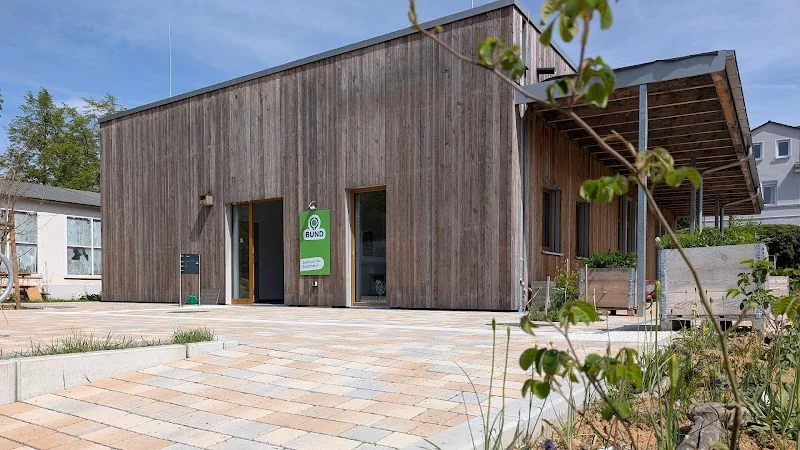
Klappacher Str. 27, Darmstadt-Bessungen
Klappacher Str. 27, 64285 Darmstadt, Germany
BUND Center for Urban Nature | Events & Urban Nature
The BUND Center for Urban Nature in Darmstadt is not a classic event building, but a place where environmental education, urban nature, climate adaptation, and practical learning intersect. In the orangery in the Bessungen district, a center is being created or has been created on parts of the former city nursery, which aims to bring people closer to nature in the city in an attractive way. BUND describes the place as a space for inclusion, ecology, networking, and environmental education; at the same time, it is used for conferences, workshops, and other formats. This mix explains why the center in Darmstadt is so strongly associated with terms like urban nature center, biodiversity, workshops, and events. It is a place where not only knowledge is conveyed but also experimented with, discussed, and developed together. This fits with the many inquiries around the program, directions, parking, and the center under construction. Those who come here do not expect a classic event show, but a content-rich, practical place for nature, climate, and social engagement. The location in the orangery additionally ensures that architecture, garden design, and environmental education appear interconnected. ([bund-hessen.de](https://www.bund-hessen.de/fileadmin/hessen/Publikationen/BUNDmagazin/Hessenseiten-BUNDmagazin_2021-3.pdf?utm_source=openai))
Events and Program at the BUND Center for Urban Nature
The strongest search patterns around the BUND Center for Urban Nature clearly revolve around events, programs, lectures, and workshops. This is obvious, as the place is used according to BUND and the city of Darmstadt exactly for that: for professional events, discussions, advisory formats, and hybrid appointments with online participation. The BUND page for online participation in events explicitly shows that appointments take place on-site at the center and can be digitally accompanied at the same time. This is practical for visitors, as it increases participation flexibility and gives the center a modern, open event logic. This is particularly visible in topics with a strong practical reference, such as workshops on wasps and hornets or energy and heat transition events. The city of Darmstadt also refers in press releases to events in the orangery and that after lectures in the orangery environment, one could even visit the geothermal heat pump of the BUND Center for Urban Nature. This makes it clear: the center is not only a place for lectures but also a learning place where technology, nature, and everyday application come together. For seekers, it is important that the specific dates regularly appear on the BUND pages and that different participation forms apply depending on the event. ([bund-darmstadt.de](https://www.bund-darmstadt.de/webkonferenz?utm_source=openai))
Content-wise, the program primarily covers topics related to urban nature, species diversity, biodiversity, and ecological practice. BUND Darmstadt uses the place, among other things, for events where people learn how to design habitats on the windowsill, balcony, garden, or urban areas in a biodiversity-friendly way. Thus, the program is not only informative but also immediately applicable. The range extends from lectures and discussion formats to excursions and accompanying actions within projects like BioDivKultur. The city of Darmstadt and BUND reports show that the place is also used as a platform for formats that strengthen public interest in insects, urban nature, and climate-adapted construction. Therefore, those looking for a current program should not only search for the building itself but also for terms like urban nature, workshops, lectures, BioDivKultur, and climate adaptation. This way, the center becomes a building block of a larger educational landscape in Darmstadt, where environmental issues are negotiated very concretely and close to everyday life. ([bund-hessen.de](https://www.bund-hessen.de/fileadmin/hessen/Publikationen/BUNDmagazin/Endfassung-BUNDmagazin-Hessen-2-2024.pdf?utm_source=openai))
Directions, Orangery, and Parking on Klappacher Straße
For most visitors, the location is the second major topic after the program. The BUND Center for Urban Nature is located in Darmstadt-Bessungen at Klappacher Straße 27, in the vicinity of the orangery. The city of Darmstadt describes the orangery garden as a park in Bessungen between Bessunger Straße, Jahnstraße, and Klappacher Straße; the bus stop orangery is mentioned as a public transport stop. This means the address is well located in the urban structure and can be clearly found in public transport. For people coming by car, it is important that the orangery is located in a densely used district as a popular site. The city of Darmstadt announced in 2026 that the parking lot at the orangery would be integrated into a new parking management concept for Bessungen South; the previous parking times from Monday to Saturday from 8 a.m. to 6 p.m. were also mentioned as a basis. This shows that parking on-site is possible, but it adapts to municipal rules and the demand in a heavily frequented neighborhood. Therefore, anyone planning a visit should check directions and parking early, especially for evening events or larger appointments in the orangery environment. ([darmstadt.de](https://www.darmstadt.de/leben/freizeit/parks-und-gaerten/die-grossen-5))
However, the location also brings advantages. The orangery is a well-known place in Darmstadt with high recognition value, and the center for urban nature benefits from the connection of historical site, garden space, and educational place. The city describes the orangery as a baroque facility with wide axes and fountains; today the building serves as an event venue. This creates an environment that is very attractive for lectures, meetings, tours, and exchanges. For visitors, this means: the destination is not hidden somewhere on the edge of the city, but in a well-connected and culturally as well as landscape-significant area. Particularly helpful is the orientation via the orangery bus stop and the mention of Klappacher Straße, as search queries are often linked with keywords like directions, orangery, parking, and Bessungen. Those planning their visit should also note that the orangery garden is embedded in the city's park and path planning and that rules or traffic directions in the vicinity may change due to municipal measures. For this reason, it is worthwhile to take a look at the current notices from the city and BUND before each visit. ([darmstadt.de](https://www.darmstadt.de/leben/freizeit/parks-und-gaerten/die-grossen-5))
History and Development of the Center for Urban Nature
The history of the BUND Center for Urban Nature begins with a clear idea: a place should be created on parts of the former city nursery in the Darmstadt orangery that makes urban nature visible, tangible, and replicable. Already in 2019, BUND received the building permit; during the same period, the city council decided on the use of the property in leasehold and a municipal investment cost subsidy. In 2020, the construction site was cleared. BUND publications make it clear that the project has since been developed step by step and has stretched over several construction and expansion phases. The official groundbreaking took place in January 2022, and the shell construction was completed in June 2023. This chronological sequence is important because it shows that the center did not simply emerge as a finished event location but as a long-term environmental education project with structural, organizational, and financial development. BUND reports also make it clear that donations and volunteer engagement significantly supported the path to completion. Thus, an idea gradually became a concrete place for the city. ([bund-hessen.de](https://www.bund-hessen.de/fileadmin/hessen/Publikationen/BUNDmagazin/Hessenseiten-BUNDmagazin_2021-3.pdf?utm_source=openai))
Content-wise, the project was conceived from the outset as larger than just a single building. BUND described three areas: a building, gardens of diversity, and educational gardens. The goal was to make large areas newly accessible and to design them in a way that encourages replication, for example, for balconies, windowsills, or gardens. This makes it understandable why search queries often target not only the location itself but also topics like under construction, center for urban nature, BUND urban nature, and urban nature center. The development of the project was also closely linked to the idea of bringing people closer to nature in the city and promoting urban biological diversity. In 2023, BUND Hessen wrote that a place for networking, experimentation, and development should emerge in the center that could also have an impact beyond Darmstadt. In 2024 and 2025, it became visible that the place is increasingly used for events and accompanying activities. The project is thus not only a construction story but also a story of programming, participation, and environmental education in the city. ([bund-hessen.de](https://www.bund-hessen.de/fileadmin/hessen/Publikationen/BUNDmagazin/Hessenseiten-BUNDmagazin_2023-3.pdf?utm_source=openai))
Facilities, Rooms, and Sustainable Construction
Even though the center is not a classic concert or conference hall, it has a very clearly defined architectural identity. The city of Darmstadt emphasized in 2025 that BUND received the Climate Award for the Center for Urban Nature in the category of climate protection and climate adaptation. An efficiency house with passive house components at Klappacher Straße 27 was honored, which uses regenerative energies through geothermal heat pump and photovoltaic system and works with green roofs, external shading devices, and biodiverse planted outdoor areas. This description shows that the facilities are not only functional but also part of the message of the house: the building itself is an example of what sustainable construction can look like in an urban environment. The architecture thus becomes a learning object. Visitors not only experience content about climate adaptation but see it concretely implemented in the building and outdoor area. This connection between building technology and environmental education makes the special appeal of the place. ([darmstadt.de](https://www.darmstadt.de/presseportal/pressemitteilungen/einzelansicht/klimapreis-2025))
BUND reports complement this picture with further concrete features. Already during the construction phase, a modern ventilation system, efficient materials, and ecological planning were prioritized. The annual reports published in 2023 describe the shell construction, bird-friendly window glass, and further facilities with heating, ventilation, electrical, and sanitary systems. A cistern was also installed, which was dimensioned larger with regard to heavy rainfall events. Together with the outdoor areas, a place is created that does not treat sustainability abstractly but makes it tangible through a real building. For use as an event venue, it is also important that the house has sufficiently large rooms and meeting opportunities, even outdoors. Thus, it is suitable for groups, seminars, exchange formats, and smaller public events. However, those looking for a room plan or classic capacity quickly realize: the center is designed more as a flexible educational and project location than as a large multipurpose hall. Its strength lies less in a fixed seating arrangement than in the connection of indoor space, outdoor space, and environmental educational use. ([bund-hessen.de](https://www.bund-hessen.de/fileadmin/hessen/Publikationen/BUNDmagazin/Hessenseiten-BUNDmagazin_2023-3.pdf?utm_source=openai))
Urban Nature Guides, BioDivKultur, and Environmental Education on Site
A central theme around the BUND Center for Urban Nature is the urban nature guides. BUND Darmstadt describes them as a consulting service for biodiversity-promoting measures. The focus is on windowsills, balconies, terraces, gardens, roofs, and even the tree disc in front of the house. The guides advise on which native wild perennials grow well, how it can bloom all year round, and what preparation and care help biodiversity. This is particularly relevant for search queries like BUND urban nature, urban nature center, or center for urban nature because here not only a building is meant, but a whole network of knowledge, practice, and participation. The urban nature guides meet at the BUND Center for Urban Nature, making the place a real hub for consulting and implementation. This is significant for Darmstadt because environmental education thus transitions from theoretical lectures to the concrete design of urban space. Therefore, those researching the location quickly encounter a usage profile that goes far beyond classic events. ([bund-darmstadt.de](https://www.bund-darmstadt.de/stadtnaturguides/?utm_source=openai))
In addition, the BioDivKultur project integrates the place as a practical partner. The BUND Hessen reports explain that BUND Darmstadt works on this project together with TU Darmstadt, bioversum Jagdschloss Kranichstein, the landscape conservation association Landkreis Göttingen, and the science city of Darmstadt. Among other things, learning paths, tiny insect gardens, exhibitions like Wiesion, and an accompanying program of excursions, dialogues, workshops, and lectures are mentioned. Here, the added value of the center becomes apparent: it is not only a space for events but part of a project that brings urban biodiversity into the public eye. The mix of research partners, municipal actors, and volunteer environmental engagement makes the place particularly significant for Darmstadt. Visitors receive not only information but a practical laboratory for urban nature. This is also the reason why terms like biodiversity, climate adaptation, and environmental education are so closely associated with the center. Those searching for the BUND Center for Urban Nature are often also looking for methods, ideas, and role models for a more nature-friendly city. ([bund-hessen.de](https://www.bund-hessen.de/fileadmin/hessen/Publikationen/BUNDmagazin/Endfassung-BUNDmagazin-Hessen-2-2024.pdf?utm_source=openai))
Special Features, Awards, and Why This Place Shapes Darmstadt
The Center for Urban Nature is not only a new building but also an award-winning example of sustainable construction and urban development. The city of Darmstadt awarded BUND the Climate Award in 2025 for the overall measure of climate protection and climate adaptation. This is a strong signal because it honors not only a technical detail but the entire concept of the place. The combination of geothermal heat pump, photovoltaics, passive house components, green roof, shading, and biodiverse outdoor space is more than a construction solution in this form. It makes the building a visible argument for climate-adapted urban development. In a time when terms like climate adaptation, sustainability, and biodiversity often seem abstract, the BUND Center for Urban Nature provides a concrete place where these topics become physically tangible. This also explains why search intentions often target history, events, and practical visitor information simultaneously. The location is not static but evolves through use, content, and outdoor space. ([darmstadt.de](https://www.darmstadt.de/presseportal/pressemitteilungen/einzelansicht/klimapreis-2025))
For Darmstadt, the place has a second significance: it connects to the orangery as a historically and urbanistically significant space and expands it with a contemporary environmental education function. The city describes the orangery as a baroque facility with a long history; the Center for Urban Nature adds a new content layer to this backdrop. Here, historical park landscape, municipal environmental policy, civil society engagement, and educational work come together. At the same time, the events surrounding solar parties, heating cellars, wasps, hornets, and urban nature show that the place translates current ecological questions into concrete learning opportunities. Exactly therein lies its special strength: it connects not only nature and city but also past and future. Those visiting this location experience Darmstadt not as a finished state but as a city in active change. The center is thus a credible, visible, and useful place for all those interested in nature in the city, sustainable construction, and practical environmental education. ([darmstadt.de](https://www.darmstadt.de/leben/freizeit/parks-und-gaerten/die-grossen-5))
Sources:
- BUND Darmstadt – Participation in Online Events
- BUND Darmstadt – Urban Nature Guides
- BUND Hessen – BUNDmagazin 2021-3
- BUND Hessen – BUNDmagazin 2023-3
- Science City Darmstadt – The Big Five / Orangery
- Science City Darmstadt – Climate Award 2025
- Science City Darmstadt – Bringing Together Electricity and Heat
Show moreShow less
BUND Center for Urban Nature | Events & Urban Nature
The BUND Center for Urban Nature in Darmstadt is not a classic event building, but a place where environmental education, urban nature, climate adaptation, and practical learning intersect. In the orangery in the Bessungen district, a center is being created or has been created on parts of the former city nursery, which aims to bring people closer to nature in the city in an attractive way. BUND describes the place as a space for inclusion, ecology, networking, and environmental education; at the same time, it is used for conferences, workshops, and other formats. This mix explains why the center in Darmstadt is so strongly associated with terms like urban nature center, biodiversity, workshops, and events. It is a place where not only knowledge is conveyed but also experimented with, discussed, and developed together. This fits with the many inquiries around the program, directions, parking, and the center under construction. Those who come here do not expect a classic event show, but a content-rich, practical place for nature, climate, and social engagement. The location in the orangery additionally ensures that architecture, garden design, and environmental education appear interconnected. ([bund-hessen.de](https://www.bund-hessen.de/fileadmin/hessen/Publikationen/BUNDmagazin/Hessenseiten-BUNDmagazin_2021-3.pdf?utm_source=openai))
Events and Program at the BUND Center for Urban Nature
The strongest search patterns around the BUND Center for Urban Nature clearly revolve around events, programs, lectures, and workshops. This is obvious, as the place is used according to BUND and the city of Darmstadt exactly for that: for professional events, discussions, advisory formats, and hybrid appointments with online participation. The BUND page for online participation in events explicitly shows that appointments take place on-site at the center and can be digitally accompanied at the same time. This is practical for visitors, as it increases participation flexibility and gives the center a modern, open event logic. This is particularly visible in topics with a strong practical reference, such as workshops on wasps and hornets or energy and heat transition events. The city of Darmstadt also refers in press releases to events in the orangery and that after lectures in the orangery environment, one could even visit the geothermal heat pump of the BUND Center for Urban Nature. This makes it clear: the center is not only a place for lectures but also a learning place where technology, nature, and everyday application come together. For seekers, it is important that the specific dates regularly appear on the BUND pages and that different participation forms apply depending on the event. ([bund-darmstadt.de](https://www.bund-darmstadt.de/webkonferenz?utm_source=openai))
Content-wise, the program primarily covers topics related to urban nature, species diversity, biodiversity, and ecological practice. BUND Darmstadt uses the place, among other things, for events where people learn how to design habitats on the windowsill, balcony, garden, or urban areas in a biodiversity-friendly way. Thus, the program is not only informative but also immediately applicable. The range extends from lectures and discussion formats to excursions and accompanying actions within projects like BioDivKultur. The city of Darmstadt and BUND reports show that the place is also used as a platform for formats that strengthen public interest in insects, urban nature, and climate-adapted construction. Therefore, those looking for a current program should not only search for the building itself but also for terms like urban nature, workshops, lectures, BioDivKultur, and climate adaptation. This way, the center becomes a building block of a larger educational landscape in Darmstadt, where environmental issues are negotiated very concretely and close to everyday life. ([bund-hessen.de](https://www.bund-hessen.de/fileadmin/hessen/Publikationen/BUNDmagazin/Endfassung-BUNDmagazin-Hessen-2-2024.pdf?utm_source=openai))
Directions, Orangery, and Parking on Klappacher Straße
For most visitors, the location is the second major topic after the program. The BUND Center for Urban Nature is located in Darmstadt-Bessungen at Klappacher Straße 27, in the vicinity of the orangery. The city of Darmstadt describes the orangery garden as a park in Bessungen between Bessunger Straße, Jahnstraße, and Klappacher Straße; the bus stop orangery is mentioned as a public transport stop. This means the address is well located in the urban structure and can be clearly found in public transport. For people coming by car, it is important that the orangery is located in a densely used district as a popular site. The city of Darmstadt announced in 2026 that the parking lot at the orangery would be integrated into a new parking management concept for Bessungen South; the previous parking times from Monday to Saturday from 8 a.m. to 6 p.m. were also mentioned as a basis. This shows that parking on-site is possible, but it adapts to municipal rules and the demand in a heavily frequented neighborhood. Therefore, anyone planning a visit should check directions and parking early, especially for evening events or larger appointments in the orangery environment. ([darmstadt.de](https://www.darmstadt.de/leben/freizeit/parks-und-gaerten/die-grossen-5))
However, the location also brings advantages. The orangery is a well-known place in Darmstadt with high recognition value, and the center for urban nature benefits from the connection of historical site, garden space, and educational place. The city describes the orangery as a baroque facility with wide axes and fountains; today the building serves as an event venue. This creates an environment that is very attractive for lectures, meetings, tours, and exchanges. For visitors, this means: the destination is not hidden somewhere on the edge of the city, but in a well-connected and culturally as well as landscape-significant area. Particularly helpful is the orientation via the orangery bus stop and the mention of Klappacher Straße, as search queries are often linked with keywords like directions, orangery, parking, and Bessungen. Those planning their visit should also note that the orangery garden is embedded in the city's park and path planning and that rules or traffic directions in the vicinity may change due to municipal measures. For this reason, it is worthwhile to take a look at the current notices from the city and BUND before each visit. ([darmstadt.de](https://www.darmstadt.de/leben/freizeit/parks-und-gaerten/die-grossen-5))
History and Development of the Center for Urban Nature
The history of the BUND Center for Urban Nature begins with a clear idea: a place should be created on parts of the former city nursery in the Darmstadt orangery that makes urban nature visible, tangible, and replicable. Already in 2019, BUND received the building permit; during the same period, the city council decided on the use of the property in leasehold and a municipal investment cost subsidy. In 2020, the construction site was cleared. BUND publications make it clear that the project has since been developed step by step and has stretched over several construction and expansion phases. The official groundbreaking took place in January 2022, and the shell construction was completed in June 2023. This chronological sequence is important because it shows that the center did not simply emerge as a finished event location but as a long-term environmental education project with structural, organizational, and financial development. BUND reports also make it clear that donations and volunteer engagement significantly supported the path to completion. Thus, an idea gradually became a concrete place for the city. ([bund-hessen.de](https://www.bund-hessen.de/fileadmin/hessen/Publikationen/BUNDmagazin/Hessenseiten-BUNDmagazin_2021-3.pdf?utm_source=openai))
Content-wise, the project was conceived from the outset as larger than just a single building. BUND described three areas: a building, gardens of diversity, and educational gardens. The goal was to make large areas newly accessible and to design them in a way that encourages replication, for example, for balconies, windowsills, or gardens. This makes it understandable why search queries often target not only the location itself but also topics like under construction, center for urban nature, BUND urban nature, and urban nature center. The development of the project was also closely linked to the idea of bringing people closer to nature in the city and promoting urban biological diversity. In 2023, BUND Hessen wrote that a place for networking, experimentation, and development should emerge in the center that could also have an impact beyond Darmstadt. In 2024 and 2025, it became visible that the place is increasingly used for events and accompanying activities. The project is thus not only a construction story but also a story of programming, participation, and environmental education in the city. ([bund-hessen.de](https://www.bund-hessen.de/fileadmin/hessen/Publikationen/BUNDmagazin/Hessenseiten-BUNDmagazin_2023-3.pdf?utm_source=openai))
Facilities, Rooms, and Sustainable Construction
Even though the center is not a classic concert or conference hall, it has a very clearly defined architectural identity. The city of Darmstadt emphasized in 2025 that BUND received the Climate Award for the Center for Urban Nature in the category of climate protection and climate adaptation. An efficiency house with passive house components at Klappacher Straße 27 was honored, which uses regenerative energies through geothermal heat pump and photovoltaic system and works with green roofs, external shading devices, and biodiverse planted outdoor areas. This description shows that the facilities are not only functional but also part of the message of the house: the building itself is an example of what sustainable construction can look like in an urban environment. The architecture thus becomes a learning object. Visitors not only experience content about climate adaptation but see it concretely implemented in the building and outdoor area. This connection between building technology and environmental education makes the special appeal of the place. ([darmstadt.de](https://www.darmstadt.de/presseportal/pressemitteilungen/einzelansicht/klimapreis-2025))
BUND reports complement this picture with further concrete features. Already during the construction phase, a modern ventilation system, efficient materials, and ecological planning were prioritized. The annual reports published in 2023 describe the shell construction, bird-friendly window glass, and further facilities with heating, ventilation, electrical, and sanitary systems. A cistern was also installed, which was dimensioned larger with regard to heavy rainfall events. Together with the outdoor areas, a place is created that does not treat sustainability abstractly but makes it tangible through a real building. For use as an event venue, it is also important that the house has sufficiently large rooms and meeting opportunities, even outdoors. Thus, it is suitable for groups, seminars, exchange formats, and smaller public events. However, those looking for a room plan or classic capacity quickly realize: the center is designed more as a flexible educational and project location than as a large multipurpose hall. Its strength lies less in a fixed seating arrangement than in the connection of indoor space, outdoor space, and environmental educational use. ([bund-hessen.de](https://www.bund-hessen.de/fileadmin/hessen/Publikationen/BUNDmagazin/Hessenseiten-BUNDmagazin_2023-3.pdf?utm_source=openai))
Urban Nature Guides, BioDivKultur, and Environmental Education on Site
A central theme around the BUND Center for Urban Nature is the urban nature guides. BUND Darmstadt describes them as a consulting service for biodiversity-promoting measures. The focus is on windowsills, balconies, terraces, gardens, roofs, and even the tree disc in front of the house. The guides advise on which native wild perennials grow well, how it can bloom all year round, and what preparation and care help biodiversity. This is particularly relevant for search queries like BUND urban nature, urban nature center, or center for urban nature because here not only a building is meant, but a whole network of knowledge, practice, and participation. The urban nature guides meet at the BUND Center for Urban Nature, making the place a real hub for consulting and implementation. This is significant for Darmstadt because environmental education thus transitions from theoretical lectures to the concrete design of urban space. Therefore, those researching the location quickly encounter a usage profile that goes far beyond classic events. ([bund-darmstadt.de](https://www.bund-darmstadt.de/stadtnaturguides/?utm_source=openai))
In addition, the BioDivKultur project integrates the place as a practical partner. The BUND Hessen reports explain that BUND Darmstadt works on this project together with TU Darmstadt, bioversum Jagdschloss Kranichstein, the landscape conservation association Landkreis Göttingen, and the science city of Darmstadt. Among other things, learning paths, tiny insect gardens, exhibitions like Wiesion, and an accompanying program of excursions, dialogues, workshops, and lectures are mentioned. Here, the added value of the center becomes apparent: it is not only a space for events but part of a project that brings urban biodiversity into the public eye. The mix of research partners, municipal actors, and volunteer environmental engagement makes the place particularly significant for Darmstadt. Visitors receive not only information but a practical laboratory for urban nature. This is also the reason why terms like biodiversity, climate adaptation, and environmental education are so closely associated with the center. Those searching for the BUND Center for Urban Nature are often also looking for methods, ideas, and role models for a more nature-friendly city. ([bund-hessen.de](https://www.bund-hessen.de/fileadmin/hessen/Publikationen/BUNDmagazin/Endfassung-BUNDmagazin-Hessen-2-2024.pdf?utm_source=openai))
Special Features, Awards, and Why This Place Shapes Darmstadt
The Center for Urban Nature is not only a new building but also an award-winning example of sustainable construction and urban development. The city of Darmstadt awarded BUND the Climate Award in 2025 for the overall measure of climate protection and climate adaptation. This is a strong signal because it honors not only a technical detail but the entire concept of the place. The combination of geothermal heat pump, photovoltaics, passive house components, green roof, shading, and biodiverse outdoor space is more than a construction solution in this form. It makes the building a visible argument for climate-adapted urban development. In a time when terms like climate adaptation, sustainability, and biodiversity often seem abstract, the BUND Center for Urban Nature provides a concrete place where these topics become physically tangible. This also explains why search intentions often target history, events, and practical visitor information simultaneously. The location is not static but evolves through use, content, and outdoor space. ([darmstadt.de](https://www.darmstadt.de/presseportal/pressemitteilungen/einzelansicht/klimapreis-2025))
For Darmstadt, the place has a second significance: it connects to the orangery as a historically and urbanistically significant space and expands it with a contemporary environmental education function. The city describes the orangery as a baroque facility with a long history; the Center for Urban Nature adds a new content layer to this backdrop. Here, historical park landscape, municipal environmental policy, civil society engagement, and educational work come together. At the same time, the events surrounding solar parties, heating cellars, wasps, hornets, and urban nature show that the place translates current ecological questions into concrete learning opportunities. Exactly therein lies its special strength: it connects not only nature and city but also past and future. Those visiting this location experience Darmstadt not as a finished state but as a city in active change. The center is thus a credible, visible, and useful place for all those interested in nature in the city, sustainable construction, and practical environmental education. ([darmstadt.de](https://www.darmstadt.de/leben/freizeit/parks-und-gaerten/die-grossen-5))
Sources:
- BUND Darmstadt – Participation in Online Events
- BUND Darmstadt – Urban Nature Guides
- BUND Hessen – BUNDmagazin 2021-3
- BUND Hessen – BUNDmagazin 2023-3
- Science City Darmstadt – The Big Five / Orangery
- Science City Darmstadt – Climate Award 2025
- Science City Darmstadt – Bringing Together Electricity and Heat
BUND Center for Urban Nature | Events & Urban Nature
The BUND Center for Urban Nature in Darmstadt is not a classic event building, but a place where environmental education, urban nature, climate adaptation, and practical learning intersect. In the orangery in the Bessungen district, a center is being created or has been created on parts of the former city nursery, which aims to bring people closer to nature in the city in an attractive way. BUND describes the place as a space for inclusion, ecology, networking, and environmental education; at the same time, it is used for conferences, workshops, and other formats. This mix explains why the center in Darmstadt is so strongly associated with terms like urban nature center, biodiversity, workshops, and events. It is a place where not only knowledge is conveyed but also experimented with, discussed, and developed together. This fits with the many inquiries around the program, directions, parking, and the center under construction. Those who come here do not expect a classic event show, but a content-rich, practical place for nature, climate, and social engagement. The location in the orangery additionally ensures that architecture, garden design, and environmental education appear interconnected. ([bund-hessen.de](https://www.bund-hessen.de/fileadmin/hessen/Publikationen/BUNDmagazin/Hessenseiten-BUNDmagazin_2021-3.pdf?utm_source=openai))
Events and Program at the BUND Center for Urban Nature
The strongest search patterns around the BUND Center for Urban Nature clearly revolve around events, programs, lectures, and workshops. This is obvious, as the place is used according to BUND and the city of Darmstadt exactly for that: for professional events, discussions, advisory formats, and hybrid appointments with online participation. The BUND page for online participation in events explicitly shows that appointments take place on-site at the center and can be digitally accompanied at the same time. This is practical for visitors, as it increases participation flexibility and gives the center a modern, open event logic. This is particularly visible in topics with a strong practical reference, such as workshops on wasps and hornets or energy and heat transition events. The city of Darmstadt also refers in press releases to events in the orangery and that after lectures in the orangery environment, one could even visit the geothermal heat pump of the BUND Center for Urban Nature. This makes it clear: the center is not only a place for lectures but also a learning place where technology, nature, and everyday application come together. For seekers, it is important that the specific dates regularly appear on the BUND pages and that different participation forms apply depending on the event. ([bund-darmstadt.de](https://www.bund-darmstadt.de/webkonferenz?utm_source=openai))
Content-wise, the program primarily covers topics related to urban nature, species diversity, biodiversity, and ecological practice. BUND Darmstadt uses the place, among other things, for events where people learn how to design habitats on the windowsill, balcony, garden, or urban areas in a biodiversity-friendly way. Thus, the program is not only informative but also immediately applicable. The range extends from lectures and discussion formats to excursions and accompanying actions within projects like BioDivKultur. The city of Darmstadt and BUND reports show that the place is also used as a platform for formats that strengthen public interest in insects, urban nature, and climate-adapted construction. Therefore, those looking for a current program should not only search for the building itself but also for terms like urban nature, workshops, lectures, BioDivKultur, and climate adaptation. This way, the center becomes a building block of a larger educational landscape in Darmstadt, where environmental issues are negotiated very concretely and close to everyday life. ([bund-hessen.de](https://www.bund-hessen.de/fileadmin/hessen/Publikationen/BUNDmagazin/Endfassung-BUNDmagazin-Hessen-2-2024.pdf?utm_source=openai))
Directions, Orangery, and Parking on Klappacher Straße
For most visitors, the location is the second major topic after the program. The BUND Center for Urban Nature is located in Darmstadt-Bessungen at Klappacher Straße 27, in the vicinity of the orangery. The city of Darmstadt describes the orangery garden as a park in Bessungen between Bessunger Straße, Jahnstraße, and Klappacher Straße; the bus stop orangery is mentioned as a public transport stop. This means the address is well located in the urban structure and can be clearly found in public transport. For people coming by car, it is important that the orangery is located in a densely used district as a popular site. The city of Darmstadt announced in 2026 that the parking lot at the orangery would be integrated into a new parking management concept for Bessungen South; the previous parking times from Monday to Saturday from 8 a.m. to 6 p.m. were also mentioned as a basis. This shows that parking on-site is possible, but it adapts to municipal rules and the demand in a heavily frequented neighborhood. Therefore, anyone planning a visit should check directions and parking early, especially for evening events or larger appointments in the orangery environment. ([darmstadt.de](https://www.darmstadt.de/leben/freizeit/parks-und-gaerten/die-grossen-5))
However, the location also brings advantages. The orangery is a well-known place in Darmstadt with high recognition value, and the center for urban nature benefits from the connection of historical site, garden space, and educational place. The city describes the orangery as a baroque facility with wide axes and fountains; today the building serves as an event venue. This creates an environment that is very attractive for lectures, meetings, tours, and exchanges. For visitors, this means: the destination is not hidden somewhere on the edge of the city, but in a well-connected and culturally as well as landscape-significant area. Particularly helpful is the orientation via the orangery bus stop and the mention of Klappacher Straße, as search queries are often linked with keywords like directions, orangery, parking, and Bessungen. Those planning their visit should also note that the orangery garden is embedded in the city's park and path planning and that rules or traffic directions in the vicinity may change due to municipal measures. For this reason, it is worthwhile to take a look at the current notices from the city and BUND before each visit. ([darmstadt.de](https://www.darmstadt.de/leben/freizeit/parks-und-gaerten/die-grossen-5))
History and Development of the Center for Urban Nature
The history of the BUND Center for Urban Nature begins with a clear idea: a place should be created on parts of the former city nursery in the Darmstadt orangery that makes urban nature visible, tangible, and replicable. Already in 2019, BUND received the building permit; during the same period, the city council decided on the use of the property in leasehold and a municipal investment cost subsidy. In 2020, the construction site was cleared. BUND publications make it clear that the project has since been developed step by step and has stretched over several construction and expansion phases. The official groundbreaking took place in January 2022, and the shell construction was completed in June 2023. This chronological sequence is important because it shows that the center did not simply emerge as a finished event location but as a long-term environmental education project with structural, organizational, and financial development. BUND reports also make it clear that donations and volunteer engagement significantly supported the path to completion. Thus, an idea gradually became a concrete place for the city. ([bund-hessen.de](https://www.bund-hessen.de/fileadmin/hessen/Publikationen/BUNDmagazin/Hessenseiten-BUNDmagazin_2021-3.pdf?utm_source=openai))
Content-wise, the project was conceived from the outset as larger than just a single building. BUND described three areas: a building, gardens of diversity, and educational gardens. The goal was to make large areas newly accessible and to design them in a way that encourages replication, for example, for balconies, windowsills, or gardens. This makes it understandable why search queries often target not only the location itself but also topics like under construction, center for urban nature, BUND urban nature, and urban nature center. The development of the project was also closely linked to the idea of bringing people closer to nature in the city and promoting urban biological diversity. In 2023, BUND Hessen wrote that a place for networking, experimentation, and development should emerge in the center that could also have an impact beyond Darmstadt. In 2024 and 2025, it became visible that the place is increasingly used for events and accompanying activities. The project is thus not only a construction story but also a story of programming, participation, and environmental education in the city. ([bund-hessen.de](https://www.bund-hessen.de/fileadmin/hessen/Publikationen/BUNDmagazin/Hessenseiten-BUNDmagazin_2023-3.pdf?utm_source=openai))
Facilities, Rooms, and Sustainable Construction
Even though the center is not a classic concert or conference hall, it has a very clearly defined architectural identity. The city of Darmstadt emphasized in 2025 that BUND received the Climate Award for the Center for Urban Nature in the category of climate protection and climate adaptation. An efficiency house with passive house components at Klappacher Straße 27 was honored, which uses regenerative energies through geothermal heat pump and photovoltaic system and works with green roofs, external shading devices, and biodiverse planted outdoor areas. This description shows that the facilities are not only functional but also part of the message of the house: the building itself is an example of what sustainable construction can look like in an urban environment. The architecture thus becomes a learning object. Visitors not only experience content about climate adaptation but see it concretely implemented in the building and outdoor area. This connection between building technology and environmental education makes the special appeal of the place. ([darmstadt.de](https://www.darmstadt.de/presseportal/pressemitteilungen/einzelansicht/klimapreis-2025))
BUND reports complement this picture with further concrete features. Already during the construction phase, a modern ventilation system, efficient materials, and ecological planning were prioritized. The annual reports published in 2023 describe the shell construction, bird-friendly window glass, and further facilities with heating, ventilation, electrical, and sanitary systems. A cistern was also installed, which was dimensioned larger with regard to heavy rainfall events. Together with the outdoor areas, a place is created that does not treat sustainability abstractly but makes it tangible through a real building. For use as an event venue, it is also important that the house has sufficiently large rooms and meeting opportunities, even outdoors. Thus, it is suitable for groups, seminars, exchange formats, and smaller public events. However, those looking for a room plan or classic capacity quickly realize: the center is designed more as a flexible educational and project location than as a large multipurpose hall. Its strength lies less in a fixed seating arrangement than in the connection of indoor space, outdoor space, and environmental educational use. ([bund-hessen.de](https://www.bund-hessen.de/fileadmin/hessen/Publikationen/BUNDmagazin/Hessenseiten-BUNDmagazin_2023-3.pdf?utm_source=openai))
Urban Nature Guides, BioDivKultur, and Environmental Education on Site
A central theme around the BUND Center for Urban Nature is the urban nature guides. BUND Darmstadt describes them as a consulting service for biodiversity-promoting measures. The focus is on windowsills, balconies, terraces, gardens, roofs, and even the tree disc in front of the house. The guides advise on which native wild perennials grow well, how it can bloom all year round, and what preparation and care help biodiversity. This is particularly relevant for search queries like BUND urban nature, urban nature center, or center for urban nature because here not only a building is meant, but a whole network of knowledge, practice, and participation. The urban nature guides meet at the BUND Center for Urban Nature, making the place a real hub for consulting and implementation. This is significant for Darmstadt because environmental education thus transitions from theoretical lectures to the concrete design of urban space. Therefore, those researching the location quickly encounter a usage profile that goes far beyond classic events. ([bund-darmstadt.de](https://www.bund-darmstadt.de/stadtnaturguides/?utm_source=openai))
In addition, the BioDivKultur project integrates the place as a practical partner. The BUND Hessen reports explain that BUND Darmstadt works on this project together with TU Darmstadt, bioversum Jagdschloss Kranichstein, the landscape conservation association Landkreis Göttingen, and the science city of Darmstadt. Among other things, learning paths, tiny insect gardens, exhibitions like Wiesion, and an accompanying program of excursions, dialogues, workshops, and lectures are mentioned. Here, the added value of the center becomes apparent: it is not only a space for events but part of a project that brings urban biodiversity into the public eye. The mix of research partners, municipal actors, and volunteer environmental engagement makes the place particularly significant for Darmstadt. Visitors receive not only information but a practical laboratory for urban nature. This is also the reason why terms like biodiversity, climate adaptation, and environmental education are so closely associated with the center. Those searching for the BUND Center for Urban Nature are often also looking for methods, ideas, and role models for a more nature-friendly city. ([bund-hessen.de](https://www.bund-hessen.de/fileadmin/hessen/Publikationen/BUNDmagazin/Endfassung-BUNDmagazin-Hessen-2-2024.pdf?utm_source=openai))
Special Features, Awards, and Why This Place Shapes Darmstadt
The Center for Urban Nature is not only a new building but also an award-winning example of sustainable construction and urban development. The city of Darmstadt awarded BUND the Climate Award in 2025 for the overall measure of climate protection and climate adaptation. This is a strong signal because it honors not only a technical detail but the entire concept of the place. The combination of geothermal heat pump, photovoltaics, passive house components, green roof, shading, and biodiverse outdoor space is more than a construction solution in this form. It makes the building a visible argument for climate-adapted urban development. In a time when terms like climate adaptation, sustainability, and biodiversity often seem abstract, the BUND Center for Urban Nature provides a concrete place where these topics become physically tangible. This also explains why search intentions often target history, events, and practical visitor information simultaneously. The location is not static but evolves through use, content, and outdoor space. ([darmstadt.de](https://www.darmstadt.de/presseportal/pressemitteilungen/einzelansicht/klimapreis-2025))
For Darmstadt, the place has a second significance: it connects to the orangery as a historically and urbanistically significant space and expands it with a contemporary environmental education function. The city describes the orangery as a baroque facility with a long history; the Center for Urban Nature adds a new content layer to this backdrop. Here, historical park landscape, municipal environmental policy, civil society engagement, and educational work come together. At the same time, the events surrounding solar parties, heating cellars, wasps, hornets, and urban nature show that the place translates current ecological questions into concrete learning opportunities. Exactly therein lies its special strength: it connects not only nature and city but also past and future. Those visiting this location experience Darmstadt not as a finished state but as a city in active change. The center is thus a credible, visible, and useful place for all those interested in nature in the city, sustainable construction, and practical environmental education. ([darmstadt.de](https://www.darmstadt.de/leben/freizeit/parks-und-gaerten/die-grossen-5))
Sources:
- BUND Darmstadt – Participation in Online Events
- BUND Darmstadt – Urban Nature Guides
- BUND Hessen – BUNDmagazin 2021-3
- BUND Hessen – BUNDmagazin 2023-3
- Science City Darmstadt – The Big Five / Orangery
- Science City Darmstadt – Climate Award 2025
- Science City Darmstadt – Bringing Together Electricity and Heat
Upcoming Events
No events found
Frequently Asked Questions
Reviews
Steff Fuch
31. October 2025
The beautiful Orangery is a lovely event venue with good offers.
M strassy (Marco Straßburg)
18. March 2026
I love this place and regularly attend the announced events.
Şükran
17. March 2026
Alena Blaginska
16. March 2026
Bernhard Ganter
12. March 2026
A beautiful place where lectures and other events on the topic of "urban nature" are constantly taking place.