Steubenpl. 1, Darmstadt
Steubenpl. 1, 64293 Darmstadt, Germany
Kunsthalle Darmstadt | Exhibition & Opening Hours
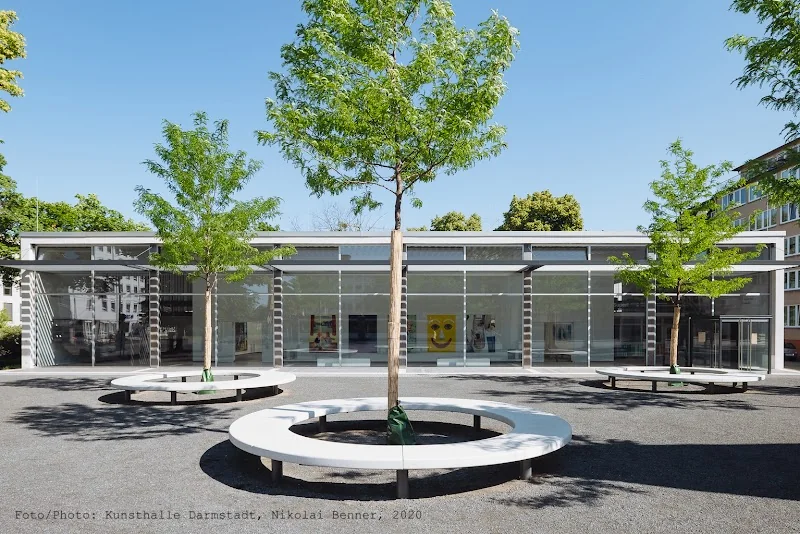
The Kunsthalle Darmstadt is much more than a classic exhibition venue: it is a cultural house with a long tradition, a distinctive building at Steubenplatz, and a program that alternates between painting, photography, sound, discussion, and project space formats. The Kunstverein Darmstadt e. V. dates back to its founding in 1833, making it one of the oldest art associations in Germany; the current building has been on the historic site since 1957 and has been further developed, expanded, and carefully renovated in the following decades. Today, the Kunsthalle combines its architectural clarity with a vibrant exhibition operation that takes current positions as seriously as it does outreach to a broad audience. ([kunsthalle-darmstadt.de](https://www.kunsthalle-darmstadt.de/History_25_1.html))
For the current season 2026, the house presents itself as particularly versatile: On the homepage, Robert Zandvliet's exhibition Paradaidha and Stefan Schwarz's image cosmos Lichtwiese are featured, while the program additionally announces discussions, workshops, and later exhibition highlights such as Wetzel + Schuster. Supermodels. Those searching for terms like exhibition, current exhibition, opening hours, admission, or Studio West will find not just a single show here, but a house with a dense, changing program. The recent exhibitions by Harm Gerdes, No Place like Home, Eingebrannt, and Ursula van Boekel also demonstrate that the Kunsthalle Darmstadt consciously engages with the present, memory, and artistic shifts in perspective. ([kunsthalle-darmstadt.de](https://www.kunsthalle-darmstadt.de/))
Opening Hours, Admission, and On-Site Visit
Anyone wishing to visit the Kunsthalle Darmstadt should first check the official opening hours. During exhibitions, the house is open from Wednesday to Sunday from 11:00 AM to 5:00 PM. Regular admission costs 10 euros, reduced 6 euros. The reductions apply, among others, to groups of 10 or more, students, trainees, retirees, people with disabilities, BBK members, the German Association for Art History, and customers of Volksbank Darmstadt Mainz. Free admission is granted to minors, members of the Kunstverein Darmstadt, press, refugees, holders of participation cards, certain associations, and other groups mentioned on the visit page. For events, the regular admission prices generally apply unless otherwise stated. ([kunsthalle-darmstadt.de](https://www.kunsthalle-darmstadt.de/Besuch_8_0.html))
The visit page is also important because it provides practical details that are crucial for planning a stress-free visit. Dogs are allowed but must be kept on a leash. At the same time, the Kunsthalle points out that the sanitary facilities and studios are not barrier-free. This is a relevant point for families, groups, and guests with mobility restrictions, as the Kunsthalle appears open and modern but is not fully accessible in all areas. Those planning a group visit or a school appointment should therefore check this information in advance and, if necessary, contact directly. This way, a spontaneous outing becomes a well-prepared visit, where the focus can truly be on the art. ([kunsthalle-darmstadt.de](https://www.kunsthalle-darmstadt.de/Besuch_8_0.html))
Guided tours are also part of the daily visit to the Kunsthalle Darmstadt. Free public tours are announced on the website, but in summer, they only take place according to museum weather or after short notice. Booked tours are possible, also in English upon request; the Kunsthalle charges 70 euros per group plus reduced admission, and for tours in English, 80 euros plus reduced admission. The maximum number of participants per tour is 25 people. There are special educational offers, workshops, and, upon request, morning openings outside regular hours for school classes and educational institutions. This mix of openness and structure makes the Kunsthalle attractive for visitors who want to not only look but really dive deeper into an exhibition theme. ([kunsthalle-darmstadt.de](https://www.kunsthalle-darmstadt.de/Vermittlung_21_0.html?utm_source=openai))
Directions, Tram, Bus, and Parking
The Kunsthalle Darmstadt is located at Steubenplatz 1, 64293 Darmstadt, directly at a location that is easily accessible by public transport. Officially mentioned are tram lines 1, 2, 4, 5, 6, 7, 8, and 9 as well as bus lines F and H; the stop is called Rhein-/Neckarstraße. For guests from the surrounding area, the route is also clearly described: By car, take the A5, exit Darmstadt Stadtmitte, continue via Rheinstraße and then Hindenburgstraße. The Kunsthalle is then located on the left. These are concrete indications that are especially helpful during larger exhibitions, evening openings, and First Friday events because they facilitate orientation directly on site. ([kunsthalle-darmstadt.de](https://www.kunsthalle-darmstadt.de/Besuch_8_0.html))
Regarding parking, it is important to know that the official visit page primarily mentions the access and does not specify a dedicated visitor parking lot. In practice, this means that those who want to be on the safe side should prefer to arrive by tram or bus or allow enough time for parking searches in the city area. The Kunsthalle itself does not make any promotional promises at this point but relies on sober visitor information. This is interesting for SEO because many users search for parking and access but ultimately need a clear, reliable route description. Therefore, those visiting the Kunsthalle benefit from the well-described public transport connections and the central location within the Darmstadt city structure. ([kunsthalle-darmstadt.de](https://www.kunsthalle-darmstadt.de/Besuch_8_0.html))
The historical location is more than just a practical detail for access. The Kunstverein Darmstadt describes the site as a culturally grown place with a long tradition: The old Kunsthalle area was already located at a historically significant intersection of urban development. Thus, the current Kunsthalle is not isolated but stands on a site that has been changing for centuries. For visitors, this creates the feeling of entering not just an exhibition but a piece of Darmstadt's cultural history. Especially in places with a strong architectural identity, the journey is therefore part of the overall experience: One does not simply arrive somewhere but at a house that is deliberately positioned between the city center, transport connections, and cultural continuity. ([kunsthalle-darmstadt.de](https://www.kunsthalle-darmstadt.de/History_25_1.html))
Current Exhibition 2026 and Program Highlights
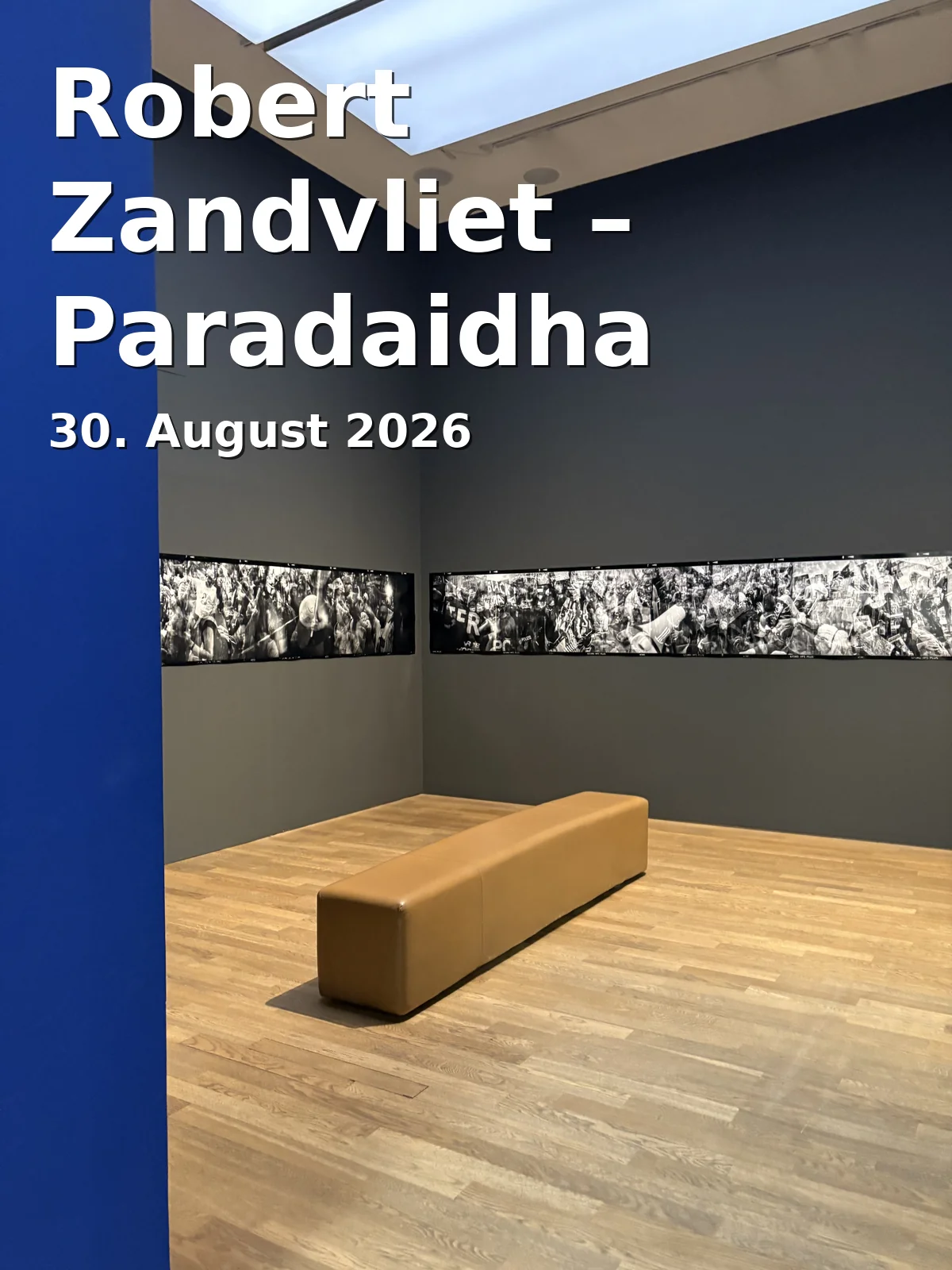
The currently most important exhibition at the Kunsthalle Darmstadt is Robert Zandvliet's Paradaidha, which is announced on the homepage from March 29, 2026, to August 30, 2026. The accompanying thought The Idea of the Garden in Painting already makes it clear that this is not about mere individual images but about an atmospheric view of nature, form, and perception. In parallel, in Studio West, Stefan Schwarz's image cosmos Lichtwiese runs from March 29, 2026, to May 24, 2026. The program page also lists several accompanying dates, including discussions with Prof. Dr. Wilhelm Schmid, Prof. Dr. Maike Sippel, Dr. Bettina Bohle, Prof. Dr. theol. Peter Zimmerling, and Prof. Dr. Thomas Fuchs, as well as workshops and evening openings with tours. The program thus consciously appears not static but as a dialogue between exhibition and public engagement. ([kunsthalle-darmstadt.de](https://www.kunsthalle-darmstadt.de/))
For search queries like current exhibition, exhibition 2026, or program, it is also important that the Kunsthalle regularly updates its formats. Wetzel + Schuster. Supermodels is already announced for May 29, 2026, on the homepage. This shows that the house not only hosts a large main exhibition but also organizes several curatorial levels in parallel. This is a strong advantage for visitors who like to return: Those coming in spring for Paradaidha will experience a different format, new discussions, and further thematic spaces throughout the year. This makes the Kunsthalle Darmstadt a place with a high motivation to return. ([kunsthalle-darmstadt.de](https://www.kunsthalle-darmstadt.de/))
The younger and most recent exhibitions also explain why keywords like Harm Gerdes, No Place like Home, Eingebrannt, or Ursula van Boekel are relevant. Harm Gerdes. Mediterranea ran from January 31, 2026, to March 15, 2026, and was announced as the largest solo exhibition of the artist to date. No Place like Home. Italian Photography since the 1980s ran from September 28, 2025, to January 11, 2026, and was described as a large-scale overview exhibition. Eingebrannt. Painting, Poetry, and New Music from the GDR showcased around 90 artists from March 30 to June 29, 2025, and connected several genres. Ursula van Boekel was present in 2025 with The City in the Forest in Studio West. This diversity clearly shows that the Kunsthalle Darmstadt cannot be reduced to a single genre. ([kunsthalle-darmstadt.de](https://www.kunsthalle-darmstadt.de/documents/khd/presse/pressebilder/noplacelikehome/mediterranea/20.01.2026pressemitteilungmediterranea.pdf?utm_source=openai))
Image material and press photos also play an important role in the current program. On the Current page, several works and press information related to Robert Zandvliet are provided, which is particularly interesting for media, visitors, and seekers with the keyword photos. Those who want to get a picture in advance will find not only titles and dates on the official pages but also visual orientation. For an art hall, this is doubly important: The images serve not only for documentation but also for expectation formation. Visitors can better prepare for atmosphere, groups of works, and spatial effects before they even enter the building. ([kunsthalle-darmstadt.de](https://www.kunsthalle-darmstadt.de/Bilder_31_0.html?utm_source=openai))
Studio West, Studio East, and the Special Rooms
A central reason why the Kunsthalle Darmstadt is so often searched is its project space concept. Studio West is not a side venue but a deliberately used experimental exhibition space on the upper floor. The official FAQ describes it as an 83 square meter room with a depth of 15.8 meters, a width of 5.2 meters, and a height of 2.90 meters. It has an open side to the foyer and is characterized by daylight and art light. In Studio West, projects are shown in close succession, consciously beyond the regular main exhibition program. This makes the Kunsthalle exciting for artists, students, school classes, and also for visitors who seek not only large retrospectives but spatial and content experiments. ([kunsthalle-darmstadt.de](https://www.kunsthalle-darmstadt.de/documents/khd/khdfaqstudiowest.pdf))
The Studio West concept is both open and participatory. According to the FAQ, anyone can apply in principle; school classes, students, less visible social groups, amateurs, and beginners in the art and exhibition business are explicitly welcomed. The jury selects the projects, and the exhibitions usually last four weeks. Therefore, those searching for Studio West will not only find a room size but a curatorial promise: Here, not only is art shown, but it is also experimented with. Openings usually take place during the main exhibitions on the first Friday of each month at 7 PM as part of First Friday. This is particularly relevant for search interest in first Friday because the term is clearly associated with the Kunsthalle in Darmstadt. ([kunsthalle-darmstadt.de](https://www.kunsthalle-darmstadt.de/documents/khd/khdfaqstudiowest.pdf))
In the current program, Studio West is occupied by Stefan Schwarz's image cosmos Lichtwiese, but the house has been using the space for very different themes for years. For example, in 2025, Ursula van Boekel's The City in the Forest ran there, an exhibition with monochrome paintings and collages that contrasts memory and forgetting. In other years, themes with strong social and spatial perspectives have also been shown in the project space. This continuity is important because it explains why users often specifically search for Studio West, photos, or certain artist names: The space is small but programmatically very visible. ([kunsthalle-darmstadt.de](https://www.kunsthalle-darmstadt.de/))
In addition to Studio West, the visit page also mentions Studio East and Studio 15. Studio East is also located on the upper floor of the Kunsthalle, while Studio 15 is operated as an online gallery. Together with the foyer, the main exhibition space, and the architecture of the house, this creates an ensemble of rooms that is ideal for changing formats. The Kunsthalle thus does not appear as a single hall but as a house with several curatorial levels. This is practical for visitors because orientation is quickly established; for SEO, it is valuable because terms like studio west, studio east, photos, or room concept appear in a contextually coherent manner. ([kunsthalle-darmstadt.de](https://www.kunsthalle-darmstadt.de/Besuch_8_0.html))
History, Architecture, and Direction
The history of the Kunsthalle Darmstadt does not begin in the 20th century but with the Kunstverein Darmstadt e. V., whose roots go back to 1833. The association was founded under the patronage of Grand Duke Ludwig II and is thus one of the oldest art associations in Germany. The development went through changing exhibition venues, the merger of several art associations in the Rhine Confederation, and finally the establishment of its own buildings. In 1889, the association received its own exhibition house in neo-Renaissance style before the old Kunsthalle was destroyed in World War II. The current Kunsthalle was built in 1957 after a competition by Theo Pabst and represents the architectural language of classical modernism of the 1950s. ([kunsthalle-darmstadt.de](https://www.kunsthalle-darmstadt.de/History_25_1.html))
Architecturally, the house is interesting because it is not only functional but also historically charged. The history refers to the redevelopment of the site, the loss of the old building in the war, and the new beginning after 1945. The current building was later expanded: In 1964, Theo Pabst added office and exhibition spaces, and in 1987, a northern extension was added. Between 2014 and 2017, the Kunsthalle was finally renovated in several stages in accordance with monument protection; during this process, the facade, skylight, and building technology were renewed, and the forecourt was redesigned. The Kunsthalle describes its building as a manifesto of a transparent new beginning, which fits very well with its current self-understanding: open but clear, traditionally anchored but content-wise mobile. ([kunsthalle-darmstadt.de](https://www.kunsthalle-darmstadt.de/History_25_1.html))
The direction is held by Dr. León Krempel, who is named as director or managing director on the team page and in the imprint. This is relevant for keyword searches like director but also for content orientation: Krempel has shaped the Kunsthalle for years with a program that connects international art, local collaborations, and educational work. His name appears on the current program page, among other things, in the accompanying formats, and he is also present as a contact person in press and exhibition announcements. This creates a profile of the house that is neither arbitrary nor purely institutional but is clearly anchored in the German art association tradition. ([kunsthalle-darmstadt.de](https://www.kunsthalle-darmstadt.de/Team_23_1.html?utm_source=openai))
The Kunsthalle Darmstadt is thus a monument, exhibition house, and place of conversation at the same time. This triple role makes it so interesting for visitors: One does not only see works but experiences a historic house that continually reinvents itself. Therefore, those searching for images, opening hours, admission, or the history of a cultural institution will find many points of connection here. The Kunsthalle is not just a venue but part of Darmstadt's city and cultural history, and this is felt both in the facade and in the program. ([kunsthalle-darmstadt.de](https://www.kunsthalle-darmstadt.de/History_25_1.html))
Reviews, Tours, and Practical Answers
The available reviews paint a very positive picture of the Kunsthalle Darmstadt. Visitors speak of a wonderful exhibition, friendly staff, and a very open space; others emphasize that the exhibitions are larger than initially assumed and that the price is also positively noted. For the perception of a house, this is important because such feedback describes the character of the place very well: The Kunsthalle is not experienced as a distant white cube but as an accessible, generous, and surprisingly open space. This mood also fits the architecture and the program, both of which focus on openness and encounter.
Those wishing to deepen their visit can take advantage of the educational offerings. The Kunsthalle offers public and booked tours, also in English upon request. The maximum group size is 25 people, and school classes can inquire about workshops and exhibition-related offers. Particularly helpful is the official statement that free group visits without a booked tour are possible, but external guides are not permitted. This is important information for organizers of group outings, school trips, and cultural journeys. The educational page also mentions an ideally three-week lead time for inquiries, which significantly eases planning. ([kunsthalle-darmstadt.de](https://www.kunsthalle-darmstadt.de/Vermittlung_21_0.html?utm_source=openai))
The Kunsthalle is also well-prepared for families and occasional visitors. The website points out that there are children's programs and that public educational institutions as well as children and young people under 18 have free admission. Additionally, there is the possibility to organize tours upon request outside regular opening hours. This makes the Kunsthalle not elitist but deliberately accessible. Therefore, those looking for a cultural destination for a Saturday, a holiday, or a thematic afternoon visit will find a place that works both informatively and atmospherically. ([kunsthalle-darmstadt.de](https://www.kunsthalle-darmstadt.de/Vermittlung_21_0.html?utm_source=openai))
For search queries like photos, jobs, or reviews: The official website regularly provides image material for current exhibitions and a section regarding employment, while reviews mainly confirm the positive, generous, and friendly impression of the house. Particularly helpful is that the Kunsthalle not only maintains a static exhibition archive but continuously updates its digital presence with current dates, press images, and program information. Therefore, those who want to check again before a visit will quickly find answers to the most important questions regarding exhibition, admission, parking, opening hours, and current program points. ([kunsthalle-darmstadt.de](https://www.kunsthalle-darmstadt.de/Bilder_31_0.html?utm_source=openai))
Sources:
- Kunsthalle Darmstadt – Homepage
- Kunsthalle Darmstadt – Visit
- Kunsthalle Darmstadt – History
- Kunsthalle Darmstadt – Team
- Kunsthalle Darmstadt – Program Exhibitions 2026
- Kunsthalle Darmstadt – Studio West FAQ
- Kunsthalle Darmstadt – Harm Gerdes. Mediterranea
- Kunsthalle Darmstadt – No Place like Home Press Release
- Kunsthalle Darmstadt – Eingebrannt
- Kunsthalle Darmstadt – Ursula van Boekel The City in the Forest
Show moreShow less
Kunsthalle Darmstadt | Exhibition & Opening Hours
The Kunsthalle Darmstadt is much more than a classic exhibition venue: it is a cultural house with a long tradition, a distinctive building at Steubenplatz, and a program that alternates between painting, photography, sound, discussion, and project space formats. The Kunstverein Darmstadt e. V. dates back to its founding in 1833, making it one of the oldest art associations in Germany; the current building has been on the historic site since 1957 and has been further developed, expanded, and carefully renovated in the following decades. Today, the Kunsthalle combines its architectural clarity with a vibrant exhibition operation that takes current positions as seriously as it does outreach to a broad audience. ([kunsthalle-darmstadt.de](https://www.kunsthalle-darmstadt.de/History_25_1.html))
For the current season 2026, the house presents itself as particularly versatile: On the homepage, Robert Zandvliet's exhibition Paradaidha and Stefan Schwarz's image cosmos Lichtwiese are featured, while the program additionally announces discussions, workshops, and later exhibition highlights such as Wetzel + Schuster. Supermodels. Those searching for terms like exhibition, current exhibition, opening hours, admission, or Studio West will find not just a single show here, but a house with a dense, changing program. The recent exhibitions by Harm Gerdes, No Place like Home, Eingebrannt, and Ursula van Boekel also demonstrate that the Kunsthalle Darmstadt consciously engages with the present, memory, and artistic shifts in perspective. ([kunsthalle-darmstadt.de](https://www.kunsthalle-darmstadt.de/))
Opening Hours, Admission, and On-Site Visit
Anyone wishing to visit the Kunsthalle Darmstadt should first check the official opening hours. During exhibitions, the house is open from Wednesday to Sunday from 11:00 AM to 5:00 PM. Regular admission costs 10 euros, reduced 6 euros. The reductions apply, among others, to groups of 10 or more, students, trainees, retirees, people with disabilities, BBK members, the German Association for Art History, and customers of Volksbank Darmstadt Mainz. Free admission is granted to minors, members of the Kunstverein Darmstadt, press, refugees, holders of participation cards, certain associations, and other groups mentioned on the visit page. For events, the regular admission prices generally apply unless otherwise stated. ([kunsthalle-darmstadt.de](https://www.kunsthalle-darmstadt.de/Besuch_8_0.html))
The visit page is also important because it provides practical details that are crucial for planning a stress-free visit. Dogs are allowed but must be kept on a leash. At the same time, the Kunsthalle points out that the sanitary facilities and studios are not barrier-free. This is a relevant point for families, groups, and guests with mobility restrictions, as the Kunsthalle appears open and modern but is not fully accessible in all areas. Those planning a group visit or a school appointment should therefore check this information in advance and, if necessary, contact directly. This way, a spontaneous outing becomes a well-prepared visit, where the focus can truly be on the art. ([kunsthalle-darmstadt.de](https://www.kunsthalle-darmstadt.de/Besuch_8_0.html))
Guided tours are also part of the daily visit to the Kunsthalle Darmstadt. Free public tours are announced on the website, but in summer, they only take place according to museum weather or after short notice. Booked tours are possible, also in English upon request; the Kunsthalle charges 70 euros per group plus reduced admission, and for tours in English, 80 euros plus reduced admission. The maximum number of participants per tour is 25 people. There are special educational offers, workshops, and, upon request, morning openings outside regular hours for school classes and educational institutions. This mix of openness and structure makes the Kunsthalle attractive for visitors who want to not only look but really dive deeper into an exhibition theme. ([kunsthalle-darmstadt.de](https://www.kunsthalle-darmstadt.de/Vermittlung_21_0.html?utm_source=openai))
Directions, Tram, Bus, and Parking
The Kunsthalle Darmstadt is located at Steubenplatz 1, 64293 Darmstadt, directly at a location that is easily accessible by public transport. Officially mentioned are tram lines 1, 2, 4, 5, 6, 7, 8, and 9 as well as bus lines F and H; the stop is called Rhein-/Neckarstraße. For guests from the surrounding area, the route is also clearly described: By car, take the A5, exit Darmstadt Stadtmitte, continue via Rheinstraße and then Hindenburgstraße. The Kunsthalle is then located on the left. These are concrete indications that are especially helpful during larger exhibitions, evening openings, and First Friday events because they facilitate orientation directly on site. ([kunsthalle-darmstadt.de](https://www.kunsthalle-darmstadt.de/Besuch_8_0.html))
Regarding parking, it is important to know that the official visit page primarily mentions the access and does not specify a dedicated visitor parking lot. In practice, this means that those who want to be on the safe side should prefer to arrive by tram or bus or allow enough time for parking searches in the city area. The Kunsthalle itself does not make any promotional promises at this point but relies on sober visitor information. This is interesting for SEO because many users search for parking and access but ultimately need a clear, reliable route description. Therefore, those visiting the Kunsthalle benefit from the well-described public transport connections and the central location within the Darmstadt city structure. ([kunsthalle-darmstadt.de](https://www.kunsthalle-darmstadt.de/Besuch_8_0.html))
The historical location is more than just a practical detail for access. The Kunstverein Darmstadt describes the site as a culturally grown place with a long tradition: The old Kunsthalle area was already located at a historically significant intersection of urban development. Thus, the current Kunsthalle is not isolated but stands on a site that has been changing for centuries. For visitors, this creates the feeling of entering not just an exhibition but a piece of Darmstadt's cultural history. Especially in places with a strong architectural identity, the journey is therefore part of the overall experience: One does not simply arrive somewhere but at a house that is deliberately positioned between the city center, transport connections, and cultural continuity. ([kunsthalle-darmstadt.de](https://www.kunsthalle-darmstadt.de/History_25_1.html))
Current Exhibition 2026 and Program Highlights
The currently most important exhibition at the Kunsthalle Darmstadt is Robert Zandvliet's Paradaidha, which is announced on the homepage from March 29, 2026, to August 30, 2026. The accompanying thought The Idea of the Garden in Painting already makes it clear that this is not about mere individual images but about an atmospheric view of nature, form, and perception. In parallel, in Studio West, Stefan Schwarz's image cosmos Lichtwiese runs from March 29, 2026, to May 24, 2026. The program page also lists several accompanying dates, including discussions with Prof. Dr. Wilhelm Schmid, Prof. Dr. Maike Sippel, Dr. Bettina Bohle, Prof. Dr. theol. Peter Zimmerling, and Prof. Dr. Thomas Fuchs, as well as workshops and evening openings with tours. The program thus consciously appears not static but as a dialogue between exhibition and public engagement. ([kunsthalle-darmstadt.de](https://www.kunsthalle-darmstadt.de/))
For search queries like current exhibition, exhibition 2026, or program, it is also important that the Kunsthalle regularly updates its formats. Wetzel + Schuster. Supermodels is already announced for May 29, 2026, on the homepage. This shows that the house not only hosts a large main exhibition but also organizes several curatorial levels in parallel. This is a strong advantage for visitors who like to return: Those coming in spring for Paradaidha will experience a different format, new discussions, and further thematic spaces throughout the year. This makes the Kunsthalle Darmstadt a place with a high motivation to return. ([kunsthalle-darmstadt.de](https://www.kunsthalle-darmstadt.de/))
The younger and most recent exhibitions also explain why keywords like Harm Gerdes, No Place like Home, Eingebrannt, or Ursula van Boekel are relevant. Harm Gerdes. Mediterranea ran from January 31, 2026, to March 15, 2026, and was announced as the largest solo exhibition of the artist to date. No Place like Home. Italian Photography since the 1980s ran from September 28, 2025, to January 11, 2026, and was described as a large-scale overview exhibition. Eingebrannt. Painting, Poetry, and New Music from the GDR showcased around 90 artists from March 30 to June 29, 2025, and connected several genres. Ursula van Boekel was present in 2025 with The City in the Forest in Studio West. This diversity clearly shows that the Kunsthalle Darmstadt cannot be reduced to a single genre. ([kunsthalle-darmstadt.de](https://www.kunsthalle-darmstadt.de/documents/khd/presse/pressebilder/noplacelikehome/mediterranea/20.01.2026pressemitteilungmediterranea.pdf?utm_source=openai))
Image material and press photos also play an important role in the current program. On the Current page, several works and press information related to Robert Zandvliet are provided, which is particularly interesting for media, visitors, and seekers with the keyword photos. Those who want to get a picture in advance will find not only titles and dates on the official pages but also visual orientation. For an art hall, this is doubly important: The images serve not only for documentation but also for expectation formation. Visitors can better prepare for atmosphere, groups of works, and spatial effects before they even enter the building. ([kunsthalle-darmstadt.de](https://www.kunsthalle-darmstadt.de/Bilder_31_0.html?utm_source=openai))
Studio West, Studio East, and the Special Rooms
A central reason why the Kunsthalle Darmstadt is so often searched is its project space concept. Studio West is not a side venue but a deliberately used experimental exhibition space on the upper floor. The official FAQ describes it as an 83 square meter room with a depth of 15.8 meters, a width of 5.2 meters, and a height of 2.90 meters. It has an open side to the foyer and is characterized by daylight and art light. In Studio West, projects are shown in close succession, consciously beyond the regular main exhibition program. This makes the Kunsthalle exciting for artists, students, school classes, and also for visitors who seek not only large retrospectives but spatial and content experiments. ([kunsthalle-darmstadt.de](https://www.kunsthalle-darmstadt.de/documents/khd/khdfaqstudiowest.pdf))
The Studio West concept is both open and participatory. According to the FAQ, anyone can apply in principle; school classes, students, less visible social groups, amateurs, and beginners in the art and exhibition business are explicitly welcomed. The jury selects the projects, and the exhibitions usually last four weeks. Therefore, those searching for Studio West will not only find a room size but a curatorial promise: Here, not only is art shown, but it is also experimented with. Openings usually take place during the main exhibitions on the first Friday of each month at 7 PM as part of First Friday. This is particularly relevant for search interest in first Friday because the term is clearly associated with the Kunsthalle in Darmstadt. ([kunsthalle-darmstadt.de](https://www.kunsthalle-darmstadt.de/documents/khd/khdfaqstudiowest.pdf))
In the current program, Studio West is occupied by Stefan Schwarz's image cosmos Lichtwiese, but the house has been using the space for very different themes for years. For example, in 2025, Ursula van Boekel's The City in the Forest ran there, an exhibition with monochrome paintings and collages that contrasts memory and forgetting. In other years, themes with strong social and spatial perspectives have also been shown in the project space. This continuity is important because it explains why users often specifically search for Studio West, photos, or certain artist names: The space is small but programmatically very visible. ([kunsthalle-darmstadt.de](https://www.kunsthalle-darmstadt.de/))
In addition to Studio West, the visit page also mentions Studio East and Studio 15. Studio East is also located on the upper floor of the Kunsthalle, while Studio 15 is operated as an online gallery. Together with the foyer, the main exhibition space, and the architecture of the house, this creates an ensemble of rooms that is ideal for changing formats. The Kunsthalle thus does not appear as a single hall but as a house with several curatorial levels. This is practical for visitors because orientation is quickly established; for SEO, it is valuable because terms like studio west, studio east, photos, or room concept appear in a contextually coherent manner. ([kunsthalle-darmstadt.de](https://www.kunsthalle-darmstadt.de/Besuch_8_0.html))
History, Architecture, and Direction
The history of the Kunsthalle Darmstadt does not begin in the 20th century but with the Kunstverein Darmstadt e. V., whose roots go back to 1833. The association was founded under the patronage of Grand Duke Ludwig II and is thus one of the oldest art associations in Germany. The development went through changing exhibition venues, the merger of several art associations in the Rhine Confederation, and finally the establishment of its own buildings. In 1889, the association received its own exhibition house in neo-Renaissance style before the old Kunsthalle was destroyed in World War II. The current Kunsthalle was built in 1957 after a competition by Theo Pabst and represents the architectural language of classical modernism of the 1950s. ([kunsthalle-darmstadt.de](https://www.kunsthalle-darmstadt.de/History_25_1.html))
Architecturally, the house is interesting because it is not only functional but also historically charged. The history refers to the redevelopment of the site, the loss of the old building in the war, and the new beginning after 1945. The current building was later expanded: In 1964, Theo Pabst added office and exhibition spaces, and in 1987, a northern extension was added. Between 2014 and 2017, the Kunsthalle was finally renovated in several stages in accordance with monument protection; during this process, the facade, skylight, and building technology were renewed, and the forecourt was redesigned. The Kunsthalle describes its building as a manifesto of a transparent new beginning, which fits very well with its current self-understanding: open but clear, traditionally anchored but content-wise mobile. ([kunsthalle-darmstadt.de](https://www.kunsthalle-darmstadt.de/History_25_1.html))
The direction is held by Dr. León Krempel, who is named as director or managing director on the team page and in the imprint. This is relevant for keyword searches like director but also for content orientation: Krempel has shaped the Kunsthalle for years with a program that connects international art, local collaborations, and educational work. His name appears on the current program page, among other things, in the accompanying formats, and he is also present as a contact person in press and exhibition announcements. This creates a profile of the house that is neither arbitrary nor purely institutional but is clearly anchored in the German art association tradition. ([kunsthalle-darmstadt.de](https://www.kunsthalle-darmstadt.de/Team_23_1.html?utm_source=openai))
The Kunsthalle Darmstadt is thus a monument, exhibition house, and place of conversation at the same time. This triple role makes it so interesting for visitors: One does not only see works but experiences a historic house that continually reinvents itself. Therefore, those searching for images, opening hours, admission, or the history of a cultural institution will find many points of connection here. The Kunsthalle is not just a venue but part of Darmstadt's city and cultural history, and this is felt both in the facade and in the program. ([kunsthalle-darmstadt.de](https://www.kunsthalle-darmstadt.de/History_25_1.html))
Reviews, Tours, and Practical Answers
The available reviews paint a very positive picture of the Kunsthalle Darmstadt. Visitors speak of a wonderful exhibition, friendly staff, and a very open space; others emphasize that the exhibitions are larger than initially assumed and that the price is also positively noted. For the perception of a house, this is important because such feedback describes the character of the place very well: The Kunsthalle is not experienced as a distant white cube but as an accessible, generous, and surprisingly open space. This mood also fits the architecture and the program, both of which focus on openness and encounter.
Those wishing to deepen their visit can take advantage of the educational offerings. The Kunsthalle offers public and booked tours, also in English upon request. The maximum group size is 25 people, and school classes can inquire about workshops and exhibition-related offers. Particularly helpful is the official statement that free group visits without a booked tour are possible, but external guides are not permitted. This is important information for organizers of group outings, school trips, and cultural journeys. The educational page also mentions an ideally three-week lead time for inquiries, which significantly eases planning. ([kunsthalle-darmstadt.de](https://www.kunsthalle-darmstadt.de/Vermittlung_21_0.html?utm_source=openai))
The Kunsthalle is also well-prepared for families and occasional visitors. The website points out that there are children's programs and that public educational institutions as well as children and young people under 18 have free admission. Additionally, there is the possibility to organize tours upon request outside regular opening hours. This makes the Kunsthalle not elitist but deliberately accessible. Therefore, those looking for a cultural destination for a Saturday, a holiday, or a thematic afternoon visit will find a place that works both informatively and atmospherically. ([kunsthalle-darmstadt.de](https://www.kunsthalle-darmstadt.de/Vermittlung_21_0.html?utm_source=openai))
For search queries like photos, jobs, or reviews: The official website regularly provides image material for current exhibitions and a section regarding employment, while reviews mainly confirm the positive, generous, and friendly impression of the house. Particularly helpful is that the Kunsthalle not only maintains a static exhibition archive but continuously updates its digital presence with current dates, press images, and program information. Therefore, those who want to check again before a visit will quickly find answers to the most important questions regarding exhibition, admission, parking, opening hours, and current program points. ([kunsthalle-darmstadt.de](https://www.kunsthalle-darmstadt.de/Bilder_31_0.html?utm_source=openai))
Sources:
- Kunsthalle Darmstadt – Homepage
- Kunsthalle Darmstadt – Visit
- Kunsthalle Darmstadt – History
- Kunsthalle Darmstadt – Team
- Kunsthalle Darmstadt – Program Exhibitions 2026
- Kunsthalle Darmstadt – Studio West FAQ
- Kunsthalle Darmstadt – Harm Gerdes. Mediterranea
- Kunsthalle Darmstadt – No Place like Home Press Release
- Kunsthalle Darmstadt – Eingebrannt
- Kunsthalle Darmstadt – Ursula van Boekel The City in the Forest
Kunsthalle Darmstadt | Exhibition & Opening Hours
The Kunsthalle Darmstadt is much more than a classic exhibition venue: it is a cultural house with a long tradition, a distinctive building at Steubenplatz, and a program that alternates between painting, photography, sound, discussion, and project space formats. The Kunstverein Darmstadt e. V. dates back to its founding in 1833, making it one of the oldest art associations in Germany; the current building has been on the historic site since 1957 and has been further developed, expanded, and carefully renovated in the following decades. Today, the Kunsthalle combines its architectural clarity with a vibrant exhibition operation that takes current positions as seriously as it does outreach to a broad audience. ([kunsthalle-darmstadt.de](https://www.kunsthalle-darmstadt.de/History_25_1.html))
For the current season 2026, the house presents itself as particularly versatile: On the homepage, Robert Zandvliet's exhibition Paradaidha and Stefan Schwarz's image cosmos Lichtwiese are featured, while the program additionally announces discussions, workshops, and later exhibition highlights such as Wetzel + Schuster. Supermodels. Those searching for terms like exhibition, current exhibition, opening hours, admission, or Studio West will find not just a single show here, but a house with a dense, changing program. The recent exhibitions by Harm Gerdes, No Place like Home, Eingebrannt, and Ursula van Boekel also demonstrate that the Kunsthalle Darmstadt consciously engages with the present, memory, and artistic shifts in perspective. ([kunsthalle-darmstadt.de](https://www.kunsthalle-darmstadt.de/))
Opening Hours, Admission, and On-Site Visit
Anyone wishing to visit the Kunsthalle Darmstadt should first check the official opening hours. During exhibitions, the house is open from Wednesday to Sunday from 11:00 AM to 5:00 PM. Regular admission costs 10 euros, reduced 6 euros. The reductions apply, among others, to groups of 10 or more, students, trainees, retirees, people with disabilities, BBK members, the German Association for Art History, and customers of Volksbank Darmstadt Mainz. Free admission is granted to minors, members of the Kunstverein Darmstadt, press, refugees, holders of participation cards, certain associations, and other groups mentioned on the visit page. For events, the regular admission prices generally apply unless otherwise stated. ([kunsthalle-darmstadt.de](https://www.kunsthalle-darmstadt.de/Besuch_8_0.html))
The visit page is also important because it provides practical details that are crucial for planning a stress-free visit. Dogs are allowed but must be kept on a leash. At the same time, the Kunsthalle points out that the sanitary facilities and studios are not barrier-free. This is a relevant point for families, groups, and guests with mobility restrictions, as the Kunsthalle appears open and modern but is not fully accessible in all areas. Those planning a group visit or a school appointment should therefore check this information in advance and, if necessary, contact directly. This way, a spontaneous outing becomes a well-prepared visit, where the focus can truly be on the art. ([kunsthalle-darmstadt.de](https://www.kunsthalle-darmstadt.de/Besuch_8_0.html))
Guided tours are also part of the daily visit to the Kunsthalle Darmstadt. Free public tours are announced on the website, but in summer, they only take place according to museum weather or after short notice. Booked tours are possible, also in English upon request; the Kunsthalle charges 70 euros per group plus reduced admission, and for tours in English, 80 euros plus reduced admission. The maximum number of participants per tour is 25 people. There are special educational offers, workshops, and, upon request, morning openings outside regular hours for school classes and educational institutions. This mix of openness and structure makes the Kunsthalle attractive for visitors who want to not only look but really dive deeper into an exhibition theme. ([kunsthalle-darmstadt.de](https://www.kunsthalle-darmstadt.de/Vermittlung_21_0.html?utm_source=openai))
Directions, Tram, Bus, and Parking
The Kunsthalle Darmstadt is located at Steubenplatz 1, 64293 Darmstadt, directly at a location that is easily accessible by public transport. Officially mentioned are tram lines 1, 2, 4, 5, 6, 7, 8, and 9 as well as bus lines F and H; the stop is called Rhein-/Neckarstraße. For guests from the surrounding area, the route is also clearly described: By car, take the A5, exit Darmstadt Stadtmitte, continue via Rheinstraße and then Hindenburgstraße. The Kunsthalle is then located on the left. These are concrete indications that are especially helpful during larger exhibitions, evening openings, and First Friday events because they facilitate orientation directly on site. ([kunsthalle-darmstadt.de](https://www.kunsthalle-darmstadt.de/Besuch_8_0.html))
Regarding parking, it is important to know that the official visit page primarily mentions the access and does not specify a dedicated visitor parking lot. In practice, this means that those who want to be on the safe side should prefer to arrive by tram or bus or allow enough time for parking searches in the city area. The Kunsthalle itself does not make any promotional promises at this point but relies on sober visitor information. This is interesting for SEO because many users search for parking and access but ultimately need a clear, reliable route description. Therefore, those visiting the Kunsthalle benefit from the well-described public transport connections and the central location within the Darmstadt city structure. ([kunsthalle-darmstadt.de](https://www.kunsthalle-darmstadt.de/Besuch_8_0.html))
The historical location is more than just a practical detail for access. The Kunstverein Darmstadt describes the site as a culturally grown place with a long tradition: The old Kunsthalle area was already located at a historically significant intersection of urban development. Thus, the current Kunsthalle is not isolated but stands on a site that has been changing for centuries. For visitors, this creates the feeling of entering not just an exhibition but a piece of Darmstadt's cultural history. Especially in places with a strong architectural identity, the journey is therefore part of the overall experience: One does not simply arrive somewhere but at a house that is deliberately positioned between the city center, transport connections, and cultural continuity. ([kunsthalle-darmstadt.de](https://www.kunsthalle-darmstadt.de/History_25_1.html))
Current Exhibition 2026 and Program Highlights
The currently most important exhibition at the Kunsthalle Darmstadt is Robert Zandvliet's Paradaidha, which is announced on the homepage from March 29, 2026, to August 30, 2026. The accompanying thought The Idea of the Garden in Painting already makes it clear that this is not about mere individual images but about an atmospheric view of nature, form, and perception. In parallel, in Studio West, Stefan Schwarz's image cosmos Lichtwiese runs from March 29, 2026, to May 24, 2026. The program page also lists several accompanying dates, including discussions with Prof. Dr. Wilhelm Schmid, Prof. Dr. Maike Sippel, Dr. Bettina Bohle, Prof. Dr. theol. Peter Zimmerling, and Prof. Dr. Thomas Fuchs, as well as workshops and evening openings with tours. The program thus consciously appears not static but as a dialogue between exhibition and public engagement. ([kunsthalle-darmstadt.de](https://www.kunsthalle-darmstadt.de/))
For search queries like current exhibition, exhibition 2026, or program, it is also important that the Kunsthalle regularly updates its formats. Wetzel + Schuster. Supermodels is already announced for May 29, 2026, on the homepage. This shows that the house not only hosts a large main exhibition but also organizes several curatorial levels in parallel. This is a strong advantage for visitors who like to return: Those coming in spring for Paradaidha will experience a different format, new discussions, and further thematic spaces throughout the year. This makes the Kunsthalle Darmstadt a place with a high motivation to return. ([kunsthalle-darmstadt.de](https://www.kunsthalle-darmstadt.de/))
The younger and most recent exhibitions also explain why keywords like Harm Gerdes, No Place like Home, Eingebrannt, or Ursula van Boekel are relevant. Harm Gerdes. Mediterranea ran from January 31, 2026, to March 15, 2026, and was announced as the largest solo exhibition of the artist to date. No Place like Home. Italian Photography since the 1980s ran from September 28, 2025, to January 11, 2026, and was described as a large-scale overview exhibition. Eingebrannt. Painting, Poetry, and New Music from the GDR showcased around 90 artists from March 30 to June 29, 2025, and connected several genres. Ursula van Boekel was present in 2025 with The City in the Forest in Studio West. This diversity clearly shows that the Kunsthalle Darmstadt cannot be reduced to a single genre. ([kunsthalle-darmstadt.de](https://www.kunsthalle-darmstadt.de/documents/khd/presse/pressebilder/noplacelikehome/mediterranea/20.01.2026pressemitteilungmediterranea.pdf?utm_source=openai))
Image material and press photos also play an important role in the current program. On the Current page, several works and press information related to Robert Zandvliet are provided, which is particularly interesting for media, visitors, and seekers with the keyword photos. Those who want to get a picture in advance will find not only titles and dates on the official pages but also visual orientation. For an art hall, this is doubly important: The images serve not only for documentation but also for expectation formation. Visitors can better prepare for atmosphere, groups of works, and spatial effects before they even enter the building. ([kunsthalle-darmstadt.de](https://www.kunsthalle-darmstadt.de/Bilder_31_0.html?utm_source=openai))
Studio West, Studio East, and the Special Rooms
A central reason why the Kunsthalle Darmstadt is so often searched is its project space concept. Studio West is not a side venue but a deliberately used experimental exhibition space on the upper floor. The official FAQ describes it as an 83 square meter room with a depth of 15.8 meters, a width of 5.2 meters, and a height of 2.90 meters. It has an open side to the foyer and is characterized by daylight and art light. In Studio West, projects are shown in close succession, consciously beyond the regular main exhibition program. This makes the Kunsthalle exciting for artists, students, school classes, and also for visitors who seek not only large retrospectives but spatial and content experiments. ([kunsthalle-darmstadt.de](https://www.kunsthalle-darmstadt.de/documents/khd/khdfaqstudiowest.pdf))
The Studio West concept is both open and participatory. According to the FAQ, anyone can apply in principle; school classes, students, less visible social groups, amateurs, and beginners in the art and exhibition business are explicitly welcomed. The jury selects the projects, and the exhibitions usually last four weeks. Therefore, those searching for Studio West will not only find a room size but a curatorial promise: Here, not only is art shown, but it is also experimented with. Openings usually take place during the main exhibitions on the first Friday of each month at 7 PM as part of First Friday. This is particularly relevant for search interest in first Friday because the term is clearly associated with the Kunsthalle in Darmstadt. ([kunsthalle-darmstadt.de](https://www.kunsthalle-darmstadt.de/documents/khd/khdfaqstudiowest.pdf))
In the current program, Studio West is occupied by Stefan Schwarz's image cosmos Lichtwiese, but the house has been using the space for very different themes for years. For example, in 2025, Ursula van Boekel's The City in the Forest ran there, an exhibition with monochrome paintings and collages that contrasts memory and forgetting. In other years, themes with strong social and spatial perspectives have also been shown in the project space. This continuity is important because it explains why users often specifically search for Studio West, photos, or certain artist names: The space is small but programmatically very visible. ([kunsthalle-darmstadt.de](https://www.kunsthalle-darmstadt.de/))
In addition to Studio West, the visit page also mentions Studio East and Studio 15. Studio East is also located on the upper floor of the Kunsthalle, while Studio 15 is operated as an online gallery. Together with the foyer, the main exhibition space, and the architecture of the house, this creates an ensemble of rooms that is ideal for changing formats. The Kunsthalle thus does not appear as a single hall but as a house with several curatorial levels. This is practical for visitors because orientation is quickly established; for SEO, it is valuable because terms like studio west, studio east, photos, or room concept appear in a contextually coherent manner. ([kunsthalle-darmstadt.de](https://www.kunsthalle-darmstadt.de/Besuch_8_0.html))
History, Architecture, and Direction
The history of the Kunsthalle Darmstadt does not begin in the 20th century but with the Kunstverein Darmstadt e. V., whose roots go back to 1833. The association was founded under the patronage of Grand Duke Ludwig II and is thus one of the oldest art associations in Germany. The development went through changing exhibition venues, the merger of several art associations in the Rhine Confederation, and finally the establishment of its own buildings. In 1889, the association received its own exhibition house in neo-Renaissance style before the old Kunsthalle was destroyed in World War II. The current Kunsthalle was built in 1957 after a competition by Theo Pabst and represents the architectural language of classical modernism of the 1950s. ([kunsthalle-darmstadt.de](https://www.kunsthalle-darmstadt.de/History_25_1.html))
Architecturally, the house is interesting because it is not only functional but also historically charged. The history refers to the redevelopment of the site, the loss of the old building in the war, and the new beginning after 1945. The current building was later expanded: In 1964, Theo Pabst added office and exhibition spaces, and in 1987, a northern extension was added. Between 2014 and 2017, the Kunsthalle was finally renovated in several stages in accordance with monument protection; during this process, the facade, skylight, and building technology were renewed, and the forecourt was redesigned. The Kunsthalle describes its building as a manifesto of a transparent new beginning, which fits very well with its current self-understanding: open but clear, traditionally anchored but content-wise mobile. ([kunsthalle-darmstadt.de](https://www.kunsthalle-darmstadt.de/History_25_1.html))
The direction is held by Dr. León Krempel, who is named as director or managing director on the team page and in the imprint. This is relevant for keyword searches like director but also for content orientation: Krempel has shaped the Kunsthalle for years with a program that connects international art, local collaborations, and educational work. His name appears on the current program page, among other things, in the accompanying formats, and he is also present as a contact person in press and exhibition announcements. This creates a profile of the house that is neither arbitrary nor purely institutional but is clearly anchored in the German art association tradition. ([kunsthalle-darmstadt.de](https://www.kunsthalle-darmstadt.de/Team_23_1.html?utm_source=openai))
The Kunsthalle Darmstadt is thus a monument, exhibition house, and place of conversation at the same time. This triple role makes it so interesting for visitors: One does not only see works but experiences a historic house that continually reinvents itself. Therefore, those searching for images, opening hours, admission, or the history of a cultural institution will find many points of connection here. The Kunsthalle is not just a venue but part of Darmstadt's city and cultural history, and this is felt both in the facade and in the program. ([kunsthalle-darmstadt.de](https://www.kunsthalle-darmstadt.de/History_25_1.html))
Reviews, Tours, and Practical Answers
The available reviews paint a very positive picture of the Kunsthalle Darmstadt. Visitors speak of a wonderful exhibition, friendly staff, and a very open space; others emphasize that the exhibitions are larger than initially assumed and that the price is also positively noted. For the perception of a house, this is important because such feedback describes the character of the place very well: The Kunsthalle is not experienced as a distant white cube but as an accessible, generous, and surprisingly open space. This mood also fits the architecture and the program, both of which focus on openness and encounter.
Those wishing to deepen their visit can take advantage of the educational offerings. The Kunsthalle offers public and booked tours, also in English upon request. The maximum group size is 25 people, and school classes can inquire about workshops and exhibition-related offers. Particularly helpful is the official statement that free group visits without a booked tour are possible, but external guides are not permitted. This is important information for organizers of group outings, school trips, and cultural journeys. The educational page also mentions an ideally three-week lead time for inquiries, which significantly eases planning. ([kunsthalle-darmstadt.de](https://www.kunsthalle-darmstadt.de/Vermittlung_21_0.html?utm_source=openai))
The Kunsthalle is also well-prepared for families and occasional visitors. The website points out that there are children's programs and that public educational institutions as well as children and young people under 18 have free admission. Additionally, there is the possibility to organize tours upon request outside regular opening hours. This makes the Kunsthalle not elitist but deliberately accessible. Therefore, those looking for a cultural destination for a Saturday, a holiday, or a thematic afternoon visit will find a place that works both informatively and atmospherically. ([kunsthalle-darmstadt.de](https://www.kunsthalle-darmstadt.de/Vermittlung_21_0.html?utm_source=openai))
For search queries like photos, jobs, or reviews: The official website regularly provides image material for current exhibitions and a section regarding employment, while reviews mainly confirm the positive, generous, and friendly impression of the house. Particularly helpful is that the Kunsthalle not only maintains a static exhibition archive but continuously updates its digital presence with current dates, press images, and program information. Therefore, those who want to check again before a visit will quickly find answers to the most important questions regarding exhibition, admission, parking, opening hours, and current program points. ([kunsthalle-darmstadt.de](https://www.kunsthalle-darmstadt.de/Bilder_31_0.html?utm_source=openai))
Sources:
- Kunsthalle Darmstadt – Homepage
- Kunsthalle Darmstadt – Visit
- Kunsthalle Darmstadt – History
- Kunsthalle Darmstadt – Team
- Kunsthalle Darmstadt – Program Exhibitions 2026
- Kunsthalle Darmstadt – Studio West FAQ
- Kunsthalle Darmstadt – Harm Gerdes. Mediterranea
- Kunsthalle Darmstadt – No Place like Home Press Release
- Kunsthalle Darmstadt – Eingebrannt
- Kunsthalle Darmstadt – Ursula van Boekel The City in the Forest
Frequently Asked Questions
Reviews
Patrice Li
31. January 2026
Wonderful exhibition. Friendly staff. Very open space.
Assaf Shelleg
28. July 2025
Saw five site-specific sound works by Anushka Chkheidze, Jana Irmert, Nile Koetting, Nicole L'Huillier, Robert Lippok, and Svetlana Maraš—part of the IMD2025 summer courses. Very nice venue.
Ana Paula Izurieta
9. August 2023
Really nice exhibition, is bigger than you would think. The price was also good.
Terenzio Facchinetti
13. February 2026
Wonderful and impressive. Colors. Lightness, dynamics and perspectives!
Markus
3. August 2019
I was passing by and noticed music in there so I was walking inside to find out that there was actually a party going on. Unfortunately it was said to be done already but I was offered to take a look for free. Prices were at student level and staff very friendly.