
Darmstadt-Ost
64287 Darmstadt, Germany
Rosenhöhe Darmstadt | Rosarium & Park
The Rosenhöhe is one of the most distinctive green spaces in Darmstadt, unusually combining garden art, city history, and quiet relaxation. The park is located in the east of the city, between Erbacher Straße and Seitersweg, and is closely linked to the Mathildenhöhe, the city's cultural understanding, and the historical development of the city. Visitors to the Rosenhöhe do not experience an ordinary city park, but a cultivated landscape with a rosarium, rose dome, mausoleums, tea houses, gatehouses, wide meadows, and a pathway design that intentionally allows for peaceful walks. The impression is particularly strong in the rosarium, where the roses are not only planted but also staged as a defining design element. The fact that the Rosenhöhe is simultaneously freely accessible, open around the clock, and a fixed place of relaxation for many people makes it one of the most important local recreation destinations in Darmstadt. For search intents related to Rosenhöhe photos, routes, parking, or forest runs, it is especially important to note: This is not an artificial event area, but a historically grown park landscape with real atmosphere and clear identity. ([darmstadt.de](https://www.darmstadt.de/leben/freizeit/parks-und-gaerten/die-grossen-5))
Historical Park and Rosarium
The history of the Rosenhöhe begins as a landscape garden and develops over more than two centuries into a park that can today be described as a horticultural work of art. The official chronicle states that the establishment as a landscape garden began in 1817, and around 1906, the rosarium with the rose dome was created. As early as 1826, the park also became the burial site of the grand ducal family, making the Rosenhöhe not only a garden but also a landscape of memory and monuments. After World War I, the site partially served as a vegetable garden, later becoming overgrown until the 1970s. Since 1979, the park has been in municipal ownership and has been reconstructed according to historical models; in 2009, the structurally endangered rose dome was rebuilt. This sequence explains why the Rosenhöhe does not appear sterile or overly staged, but rather reveals layers of history. One can recognize in it the development from a courtly garden idea to an open, publicly used park with high quality of stay. This is precisely what attracts visitors looking for a place that not only looks beautiful but also has a real narrative. ([darmstadt.de](https://www.darmstadt.de/leben/freizeit/parks-und-gaerten/die-grossen-5))
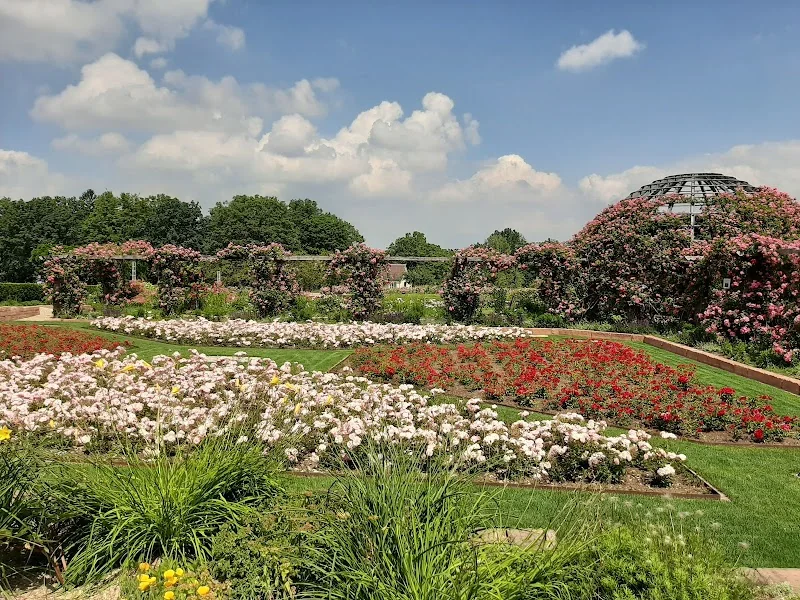
Particularly characteristic is the rosarium with the white rose dome. The city of Darmstadt describes more than 10,000 roses in over 200 species and varieties there from May to November, complemented by perennials, spring flowers, climbing plants, water lilies, and some exotic trees. This is as important for the search query for Rosenhöhe photos as it is for people who simply want to know what to expect on site. The rosarium is not only decorative but the centerpiece of the entire park. It is the area where the horticultural care is most visibly evident and where the Rosenhöhe truly lives up to its name. At the same time, the official representation shows that the park is not just made up of flower beds: Expansive meadows, good paths, benches, and architectural gems make it a place that one does not just visit for a few minutes but strolls through at leisure. Therefore, those who want to get to know the Rosenhöhe should not reduce the park to a single bloom or a single photographic motif. The charm lies precisely in the interplay of blooming diversity, historical depth, and open, park-like expanses. ([darmstadt.de](https://www.darmstadt.de/leben/freizeit/parks-und-gaerten/die-grossen-5))
Rosenhöhe Photos: Rose Dome, Rose Beds, and Special Perspectives
For photos, the Rosenhöhe Darmstadt is an exceptionally rewarding place because the park connects many motifs in short distances. The city shows the rosarium area in official images from various perspectives, such as from the plateau, along the rose beds, through trellises, under wisteria, and with a view of the rose dome. This means in practice: Those who want to take good Rosenhöhe photos should not only look straight at the beds but consciously work with heights, perspectives, and pathway lines. The rose dome is a central motif because it forms a strong contrast to the roses, perennials, and the greenery of the paths with its white, almost sculptural form. The site appears particularly attractive during the blooming months, but strong images can also be created in the evening light and transitional periods. The official image descriptions explicitly mention summery impressions, autumnal park landscapes, and flowers in the evening glow, which shows that the Rosenhöhe is not only worth seeing in high summer. For visitors who understand the search for Rosenhöhe photos more as inspiration, this is an important hint: The park thrives on light, season, and direction of view. Therefore, it is worthwhile to take several rounds and capture the same place from different angles. ([darmstadt.de](https://www.darmstadt.de/leben/freizeit/parks-und-gaerten/die-grossen-5))
In addition to the rosarium, the historical buildings also offer strong photographic motifs. Mausoleums, tea houses, gatehouses, and the open paths create a visual language that is both representative and tranquil. This mixture is rare: Many parks are either purely botanical or purely historical; the Rosenhöhe combines both. Additionally, the integration into the cityscape is particularly interesting, as the park is located in the east of Darmstadt and forms a multifaceted ensemble together with the Mathildenhöhe. For photos with orientation and context, this is important because it allows for storytelling not only about flowers but also about city history and landscape architecture. Therefore, those looking for content for social media, travel blogs, or personal memory albums will find here motifs ranging from close-up details to wide park scenes. It is advisable to plan the visit in several stages: first the rosarium with its beds and the rose dome, then the paths and meadows, followed by the historical buildings, and finally the peripheral areas with open views. This way, images are created that do not look like arbitrary city greenery but rather like a place with a clear identity and its own atmosphere. ([darmstadt.de](https://www.darmstadt.de/leben/freizeit/parks-und-gaerten/die-grossen-5))
Directions, Parking, and Route to Rosenhöhe
The approach to the Rosenhöhe is straightforward if one follows the official guidelines. The park is located in the east of Darmstadt, between Erbacher Straße and Seitersweg, and according to the city website, it is easily accessible via the Ostbahnhof stop using public transport. This is relevant for anyone searching for the Rosenhöhe Darmstadt route and who does not want to arrive by car. Additionally, the city points out that the Rosenhöhe is car-free. Therefore, parking options outside the park are mentioned, specifically in Zeyherweg or Seitersweg. This is important because the site itself does not function as a thoroughfare or short-term parking zone. For groups and tour buses, there is a separate bus parking lot on Wolfskehlstraße with space for three buses. Therefore, those preparing for a guided tour, an outing, or a family day should plan the route in advance so that the last stretch is covered on foot. Especially since the Rosenhöhe is intended as a historical park, the car-free character does not feel like a restriction but rather as part of the experience. The tranquility of the place begins upon arrival. ([darmstadt.de](https://www.darmstadt.de/leben/freizeit/parks-und-gaerten/die-grossen-5))
For specific orientation, it is worth knowing the current parking logic: During the apple harvest at the Rosenhöhe, it was explicitly pointed out that access via the Löwentor and Ludwig-Engel-Weg is not possible. This information is useful because it clarifies that the Rosenhöhe does not function like a normal driving park but rather like a protected green space with clear access rules. Those coming for events, tours, or walks should therefore expect to use footpaths, bicycles, or public transport rather than direct access to the destination. In tourist practice, a combination of disembarking and a short walk is suitable for bus groups; for individual travelers, the Ostbahnhof is the simplest orientation. Even though search terms related to Rosenhöhe route or Rosenhöhe parking often indicate car travel, the best visitor strategy here is usually the reverse: not to drive into the park but to clarify the parking situation in advance and then consciously experience the last section on foot. This way, the atmosphere of the site is preserved, and the visit begins more calmly and pleasantly. ([darmstadt.de](https://www.darmstadt.de/presseportal/pressemitteilungen/einzelansicht/apfelernte-auf-der-rosenhoehe-am-20-september?utm_source=openai))
Forest Runs, Walks, and Quiet Paths in the Park
The Rosenhöhe is not a classic sports park, but it is indeed a place for outdoor activity. The city describes the site as an oasis of tranquility with expansive meadows, well-developed paths, and benches. These features make the park attractive for walks, leisurely strolls, and even for a quiet run. Those searching for Rosenhöhe forest runs likely think of a route with a sense of nature, easy orientation, and little traffic noise. The Rosenhöhe is generally well-suited for this, even though official sources do not designate a marked running route. From this, a cautious, practical conclusion can be drawn: For a relaxed, non-competitive run, the park is a natural choice as long as one uses the paths and is considerate of other visitors. This also aligns with the recommendation from the support association to keep dogs on a leash and stay on the paths. This shows that the Rosenhöhe functions as a shared recreational space and not as a place where different uses are played against each other. Therefore, those interested in movement, nature, and tranquility will find here a stable mix of area, path surface, and landscape openness. ([darmstadt.de](https://www.darmstadt.de/leben/freizeit/parks-und-gaerten/die-grossen-5))
The combination of historical sightlines, meadows, groups of trees, and bed areas ensures that a walk in the Rosenhöhe never feels monotonous. One alternates between open and closed spaces, between flower areas and quiet peripheral regions, between strong sightlines and small architectural surprises. This is precisely what is pleasant for visitors seeking a place where one can walk, pause, and continue without time pressure. From a gardening perspective, the park is also interesting, as the city emphasizes not only the beauty of the plantings but also the importance of nature-oriented design. In a course at the Rosenhöhe, it is explained that the park is a habitat for many animal species and that even less representative areas are important for biodiversity. For a run or walk, this means: The Rosenhöhe is not just a backdrop but a living natural space. Therefore, those who are out and about here experience not just a postcard view but a park that is ecologically considered. This makes the charm of a forest run or a daily round: The movement takes place in an environment that is maintained but not over-formed. ([darmstadt.de](https://www.darmstadt.de/leben/umwelt/mitmachen-aktiv-dabei/kurse-auf-der-rosenhoehe?utm_source=openai))
Mausoleums, Tea Houses, and Architectural Highlights
A significant part of the Rosenhöhe consists of its historical buildings, especially the Old and New Mausoleum. The city explicitly describes the Rosenhöhe as a grand ducal burial site, and the monument protection authority explains that the Old Mausoleum was designed by Moller in 1826 and expanded in 1869/70, while the New Mausoleum was built from 1905 to 1910. Together with the adjacent open graves, these structures shape the monument character of the park. This is important for visitors because the Rosenhöhe is thus much more than just a rosarium. It is also a place of remembrance, family history, and architecture. Walking past the mausoleums, one experiences a stark contrast between the liveliness of the flower beds and the tranquility of the graves. The note that these areas are not barrier-free accessible is also part of the practical information that can be helpful before a visit. Therefore, for respectful planning, it is important to consider the monument character and treat the site as a historically sensitive place. ([darmstadt.de](https://www.darmstadt.de/presseportal/pressemitteilungen/einzelansicht/fuehrungen-durch-drei-mausoleen-am-tag-des-offenen-denkmals-am-14-september-2025))
Other architectural reference points include the tea house and the gatehouse, which the city mentions on its park page as visitable buildings. The support association also operates an information center in the renovated tea house, which makes the park visible organizationally. This connection of historical substance and contemporary mediation is typical for the Rosenhöhe: The place is not a museum with barriers, but it is also not just a simple walking park. Rather, its history is explained, maintained, and continued in everyday life. The collaboration between the city, the support association, and monument protection ensures that the historical elements do not fall into oblivion. During tours on the day of the open monuments, this becomes particularly evident when otherwise inaccessible interiors can be visited. Thus, the park not only shows a beautiful facade on the outside but also has a complex memory topography inside. Therefore, those interested in architecture, monuments, and Darmstadt's history should not only linger at the rosarium but also consciously plan time for the areas near the mausoleums and the smaller buildings. It is precisely there that the cultural depth of the Rosenhöhe becomes particularly tangible. ([darmstadt.de](https://www.darmstadt.de/presseportal/pressemitteilungen/einzelansicht/fuehrungen-durch-drei-mausoleen-am-tag-des-offenen-denkmals-am-14-september-2025))
Events, Tours, and Nature Experiences at the Rosenhöhe
The Rosenhöhe is not just a place to look at, but also a place for events, tours, and knowledge transfer. The city of Darmstadt regularly offers free tours and courses at the Rosenhöhe, such as on rose pruning, biodiversity, or botanical topics. Meeting points like the rosarium or the gardener's house show that the park is actively used and not just museum-managed. The support association complements this offer with its own dates, lectures, and tours and also points out that the information center in the tea house is open on weekends and holidays starting in April. This is particularly attractive for visitors because it allows them to discover the park not only individually but also to get to know it with professional guidance. Those interested in rose care, park history, or the interplay of plants and urban ecology will find more than just a beautiful backdrop at the Rosenhöhe. The site is a learning place in the green, where practical knowledge and cultural context come together. This also explains why the Rosenhöhe appears so often in urban event formats and is perceived by the population as a lively part of the recreational offerings. ([darmstadt.de](https://www.darmstadt.de/leben/umwelt/mitmachen-aktiv-dabei/kurse-auf-der-rosenhoehe?utm_source=openai))
Additionally, there is the ecological dimension. The city emphasizes that the Rosenhöhe is not only a well-maintained historical park but also a home for many animal species. Tours explain how nature-oriented design, native plants, and less representative areas promote biodiversity. This makes the park content-wise strong: It is not just pretty but also ecologically interesting. Therefore, those walking in the Rosenhöhe move through a site where monument preservation, garden art, and species diversity interact. Even measures such as planting native shrubs at the northern park boundary show that the development of the park is not complete but is continuously thought through. This also fits with the recurring care of the rose beds, the renovation of individual areas, and the ongoing work of the green space office. For visitors, this means a good mix: The Rosenhöhe appears historical but remains lively, well-maintained, and in transition. Therefore, those seeking more than just a photographic motif will find here a place that offers knowledge, movement, nature, and memory at the same time. This is what makes its rank among Darmstadt's green spaces. ([darmstadt.de](https://www.darmstadt.de/leben/umwelt/mitmachen-aktiv-dabei/kurse-auf-der-rosenhoehe?utm_source=openai))
Sources:
Show moreShow less
Rosenhöhe Darmstadt | Rosarium & Park
The Rosenhöhe is one of the most distinctive green spaces in Darmstadt, unusually combining garden art, city history, and quiet relaxation. The park is located in the east of the city, between Erbacher Straße and Seitersweg, and is closely linked to the Mathildenhöhe, the city's cultural understanding, and the historical development of the city. Visitors to the Rosenhöhe do not experience an ordinary city park, but a cultivated landscape with a rosarium, rose dome, mausoleums, tea houses, gatehouses, wide meadows, and a pathway design that intentionally allows for peaceful walks. The impression is particularly strong in the rosarium, where the roses are not only planted but also staged as a defining design element. The fact that the Rosenhöhe is simultaneously freely accessible, open around the clock, and a fixed place of relaxation for many people makes it one of the most important local recreation destinations in Darmstadt. For search intents related to Rosenhöhe photos, routes, parking, or forest runs, it is especially important to note: This is not an artificial event area, but a historically grown park landscape with real atmosphere and clear identity. ([darmstadt.de](https://www.darmstadt.de/leben/freizeit/parks-und-gaerten/die-grossen-5))
Historical Park and Rosarium
The history of the Rosenhöhe begins as a landscape garden and develops over more than two centuries into a park that can today be described as a horticultural work of art. The official chronicle states that the establishment as a landscape garden began in 1817, and around 1906, the rosarium with the rose dome was created. As early as 1826, the park also became the burial site of the grand ducal family, making the Rosenhöhe not only a garden but also a landscape of memory and monuments. After World War I, the site partially served as a vegetable garden, later becoming overgrown until the 1970s. Since 1979, the park has been in municipal ownership and has been reconstructed according to historical models; in 2009, the structurally endangered rose dome was rebuilt. This sequence explains why the Rosenhöhe does not appear sterile or overly staged, but rather reveals layers of history. One can recognize in it the development from a courtly garden idea to an open, publicly used park with high quality of stay. This is precisely what attracts visitors looking for a place that not only looks beautiful but also has a real narrative. ([darmstadt.de](https://www.darmstadt.de/leben/freizeit/parks-und-gaerten/die-grossen-5))
Particularly characteristic is the rosarium with the white rose dome. The city of Darmstadt describes more than 10,000 roses in over 200 species and varieties there from May to November, complemented by perennials, spring flowers, climbing plants, water lilies, and some exotic trees. This is as important for the search query for Rosenhöhe photos as it is for people who simply want to know what to expect on site. The rosarium is not only decorative but the centerpiece of the entire park. It is the area where the horticultural care is most visibly evident and where the Rosenhöhe truly lives up to its name. At the same time, the official representation shows that the park is not just made up of flower beds: Expansive meadows, good paths, benches, and architectural gems make it a place that one does not just visit for a few minutes but strolls through at leisure. Therefore, those who want to get to know the Rosenhöhe should not reduce the park to a single bloom or a single photographic motif. The charm lies precisely in the interplay of blooming diversity, historical depth, and open, park-like expanses. ([darmstadt.de](https://www.darmstadt.de/leben/freizeit/parks-und-gaerten/die-grossen-5))
Rosenhöhe Photos: Rose Dome, Rose Beds, and Special Perspectives
For photos, the Rosenhöhe Darmstadt is an exceptionally rewarding place because the park connects many motifs in short distances. The city shows the rosarium area in official images from various perspectives, such as from the plateau, along the rose beds, through trellises, under wisteria, and with a view of the rose dome. This means in practice: Those who want to take good Rosenhöhe photos should not only look straight at the beds but consciously work with heights, perspectives, and pathway lines. The rose dome is a central motif because it forms a strong contrast to the roses, perennials, and the greenery of the paths with its white, almost sculptural form. The site appears particularly attractive during the blooming months, but strong images can also be created in the evening light and transitional periods. The official image descriptions explicitly mention summery impressions, autumnal park landscapes, and flowers in the evening glow, which shows that the Rosenhöhe is not only worth seeing in high summer. For visitors who understand the search for Rosenhöhe photos more as inspiration, this is an important hint: The park thrives on light, season, and direction of view. Therefore, it is worthwhile to take several rounds and capture the same place from different angles. ([darmstadt.de](https://www.darmstadt.de/leben/freizeit/parks-und-gaerten/die-grossen-5))
In addition to the rosarium, the historical buildings also offer strong photographic motifs. Mausoleums, tea houses, gatehouses, and the open paths create a visual language that is both representative and tranquil. This mixture is rare: Many parks are either purely botanical or purely historical; the Rosenhöhe combines both. Additionally, the integration into the cityscape is particularly interesting, as the park is located in the east of Darmstadt and forms a multifaceted ensemble together with the Mathildenhöhe. For photos with orientation and context, this is important because it allows for storytelling not only about flowers but also about city history and landscape architecture. Therefore, those looking for content for social media, travel blogs, or personal memory albums will find here motifs ranging from close-up details to wide park scenes. It is advisable to plan the visit in several stages: first the rosarium with its beds and the rose dome, then the paths and meadows, followed by the historical buildings, and finally the peripheral areas with open views. This way, images are created that do not look like arbitrary city greenery but rather like a place with a clear identity and its own atmosphere. ([darmstadt.de](https://www.darmstadt.de/leben/freizeit/parks-und-gaerten/die-grossen-5))
Directions, Parking, and Route to Rosenhöhe
The approach to the Rosenhöhe is straightforward if one follows the official guidelines. The park is located in the east of Darmstadt, between Erbacher Straße and Seitersweg, and according to the city website, it is easily accessible via the Ostbahnhof stop using public transport. This is relevant for anyone searching for the Rosenhöhe Darmstadt route and who does not want to arrive by car. Additionally, the city points out that the Rosenhöhe is car-free. Therefore, parking options outside the park are mentioned, specifically in Zeyherweg or Seitersweg. This is important because the site itself does not function as a thoroughfare or short-term parking zone. For groups and tour buses, there is a separate bus parking lot on Wolfskehlstraße with space for three buses. Therefore, those preparing for a guided tour, an outing, or a family day should plan the route in advance so that the last stretch is covered on foot. Especially since the Rosenhöhe is intended as a historical park, the car-free character does not feel like a restriction but rather as part of the experience. The tranquility of the place begins upon arrival. ([darmstadt.de](https://www.darmstadt.de/leben/freizeit/parks-und-gaerten/die-grossen-5))
For specific orientation, it is worth knowing the current parking logic: During the apple harvest at the Rosenhöhe, it was explicitly pointed out that access via the Löwentor and Ludwig-Engel-Weg is not possible. This information is useful because it clarifies that the Rosenhöhe does not function like a normal driving park but rather like a protected green space with clear access rules. Those coming for events, tours, or walks should therefore expect to use footpaths, bicycles, or public transport rather than direct access to the destination. In tourist practice, a combination of disembarking and a short walk is suitable for bus groups; for individual travelers, the Ostbahnhof is the simplest orientation. Even though search terms related to Rosenhöhe route or Rosenhöhe parking often indicate car travel, the best visitor strategy here is usually the reverse: not to drive into the park but to clarify the parking situation in advance and then consciously experience the last section on foot. This way, the atmosphere of the site is preserved, and the visit begins more calmly and pleasantly. ([darmstadt.de](https://www.darmstadt.de/presseportal/pressemitteilungen/einzelansicht/apfelernte-auf-der-rosenhoehe-am-20-september?utm_source=openai))
Forest Runs, Walks, and Quiet Paths in the Park
The Rosenhöhe is not a classic sports park, but it is indeed a place for outdoor activity. The city describes the site as an oasis of tranquility with expansive meadows, well-developed paths, and benches. These features make the park attractive for walks, leisurely strolls, and even for a quiet run. Those searching for Rosenhöhe forest runs likely think of a route with a sense of nature, easy orientation, and little traffic noise. The Rosenhöhe is generally well-suited for this, even though official sources do not designate a marked running route. From this, a cautious, practical conclusion can be drawn: For a relaxed, non-competitive run, the park is a natural choice as long as one uses the paths and is considerate of other visitors. This also aligns with the recommendation from the support association to keep dogs on a leash and stay on the paths. This shows that the Rosenhöhe functions as a shared recreational space and not as a place where different uses are played against each other. Therefore, those interested in movement, nature, and tranquility will find here a stable mix of area, path surface, and landscape openness. ([darmstadt.de](https://www.darmstadt.de/leben/freizeit/parks-und-gaerten/die-grossen-5))
The combination of historical sightlines, meadows, groups of trees, and bed areas ensures that a walk in the Rosenhöhe never feels monotonous. One alternates between open and closed spaces, between flower areas and quiet peripheral regions, between strong sightlines and small architectural surprises. This is precisely what is pleasant for visitors seeking a place where one can walk, pause, and continue without time pressure. From a gardening perspective, the park is also interesting, as the city emphasizes not only the beauty of the plantings but also the importance of nature-oriented design. In a course at the Rosenhöhe, it is explained that the park is a habitat for many animal species and that even less representative areas are important for biodiversity. For a run or walk, this means: The Rosenhöhe is not just a backdrop but a living natural space. Therefore, those who are out and about here experience not just a postcard view but a park that is ecologically considered. This makes the charm of a forest run or a daily round: The movement takes place in an environment that is maintained but not over-formed. ([darmstadt.de](https://www.darmstadt.de/leben/umwelt/mitmachen-aktiv-dabei/kurse-auf-der-rosenhoehe?utm_source=openai))
Mausoleums, Tea Houses, and Architectural Highlights
A significant part of the Rosenhöhe consists of its historical buildings, especially the Old and New Mausoleum. The city explicitly describes the Rosenhöhe as a grand ducal burial site, and the monument protection authority explains that the Old Mausoleum was designed by Moller in 1826 and expanded in 1869/70, while the New Mausoleum was built from 1905 to 1910. Together with the adjacent open graves, these structures shape the monument character of the park. This is important for visitors because the Rosenhöhe is thus much more than just a rosarium. It is also a place of remembrance, family history, and architecture. Walking past the mausoleums, one experiences a stark contrast between the liveliness of the flower beds and the tranquility of the graves. The note that these areas are not barrier-free accessible is also part of the practical information that can be helpful before a visit. Therefore, for respectful planning, it is important to consider the monument character and treat the site as a historically sensitive place. ([darmstadt.de](https://www.darmstadt.de/presseportal/pressemitteilungen/einzelansicht/fuehrungen-durch-drei-mausoleen-am-tag-des-offenen-denkmals-am-14-september-2025))
Other architectural reference points include the tea house and the gatehouse, which the city mentions on its park page as visitable buildings. The support association also operates an information center in the renovated tea house, which makes the park visible organizationally. This connection of historical substance and contemporary mediation is typical for the Rosenhöhe: The place is not a museum with barriers, but it is also not just a simple walking park. Rather, its history is explained, maintained, and continued in everyday life. The collaboration between the city, the support association, and monument protection ensures that the historical elements do not fall into oblivion. During tours on the day of the open monuments, this becomes particularly evident when otherwise inaccessible interiors can be visited. Thus, the park not only shows a beautiful facade on the outside but also has a complex memory topography inside. Therefore, those interested in architecture, monuments, and Darmstadt's history should not only linger at the rosarium but also consciously plan time for the areas near the mausoleums and the smaller buildings. It is precisely there that the cultural depth of the Rosenhöhe becomes particularly tangible. ([darmstadt.de](https://www.darmstadt.de/presseportal/pressemitteilungen/einzelansicht/fuehrungen-durch-drei-mausoleen-am-tag-des-offenen-denkmals-am-14-september-2025))
Events, Tours, and Nature Experiences at the Rosenhöhe
The Rosenhöhe is not just a place to look at, but also a place for events, tours, and knowledge transfer. The city of Darmstadt regularly offers free tours and courses at the Rosenhöhe, such as on rose pruning, biodiversity, or botanical topics. Meeting points like the rosarium or the gardener's house show that the park is actively used and not just museum-managed. The support association complements this offer with its own dates, lectures, and tours and also points out that the information center in the tea house is open on weekends and holidays starting in April. This is particularly attractive for visitors because it allows them to discover the park not only individually but also to get to know it with professional guidance. Those interested in rose care, park history, or the interplay of plants and urban ecology will find more than just a beautiful backdrop at the Rosenhöhe. The site is a learning place in the green, where practical knowledge and cultural context come together. This also explains why the Rosenhöhe appears so often in urban event formats and is perceived by the population as a lively part of the recreational offerings. ([darmstadt.de](https://www.darmstadt.de/leben/umwelt/mitmachen-aktiv-dabei/kurse-auf-der-rosenhoehe?utm_source=openai))
Additionally, there is the ecological dimension. The city emphasizes that the Rosenhöhe is not only a well-maintained historical park but also a home for many animal species. Tours explain how nature-oriented design, native plants, and less representative areas promote biodiversity. This makes the park content-wise strong: It is not just pretty but also ecologically interesting. Therefore, those walking in the Rosenhöhe move through a site where monument preservation, garden art, and species diversity interact. Even measures such as planting native shrubs at the northern park boundary show that the development of the park is not complete but is continuously thought through. This also fits with the recurring care of the rose beds, the renovation of individual areas, and the ongoing work of the green space office. For visitors, this means a good mix: The Rosenhöhe appears historical but remains lively, well-maintained, and in transition. Therefore, those seeking more than just a photographic motif will find here a place that offers knowledge, movement, nature, and memory at the same time. This is what makes its rank among Darmstadt's green spaces. ([darmstadt.de](https://www.darmstadt.de/leben/umwelt/mitmachen-aktiv-dabei/kurse-auf-der-rosenhoehe?utm_source=openai))
Sources:
Rosenhöhe Darmstadt | Rosarium & Park
The Rosenhöhe is one of the most distinctive green spaces in Darmstadt, unusually combining garden art, city history, and quiet relaxation. The park is located in the east of the city, between Erbacher Straße and Seitersweg, and is closely linked to the Mathildenhöhe, the city's cultural understanding, and the historical development of the city. Visitors to the Rosenhöhe do not experience an ordinary city park, but a cultivated landscape with a rosarium, rose dome, mausoleums, tea houses, gatehouses, wide meadows, and a pathway design that intentionally allows for peaceful walks. The impression is particularly strong in the rosarium, where the roses are not only planted but also staged as a defining design element. The fact that the Rosenhöhe is simultaneously freely accessible, open around the clock, and a fixed place of relaxation for many people makes it one of the most important local recreation destinations in Darmstadt. For search intents related to Rosenhöhe photos, routes, parking, or forest runs, it is especially important to note: This is not an artificial event area, but a historically grown park landscape with real atmosphere and clear identity. ([darmstadt.de](https://www.darmstadt.de/leben/freizeit/parks-und-gaerten/die-grossen-5))
Historical Park and Rosarium
The history of the Rosenhöhe begins as a landscape garden and develops over more than two centuries into a park that can today be described as a horticultural work of art. The official chronicle states that the establishment as a landscape garden began in 1817, and around 1906, the rosarium with the rose dome was created. As early as 1826, the park also became the burial site of the grand ducal family, making the Rosenhöhe not only a garden but also a landscape of memory and monuments. After World War I, the site partially served as a vegetable garden, later becoming overgrown until the 1970s. Since 1979, the park has been in municipal ownership and has been reconstructed according to historical models; in 2009, the structurally endangered rose dome was rebuilt. This sequence explains why the Rosenhöhe does not appear sterile or overly staged, but rather reveals layers of history. One can recognize in it the development from a courtly garden idea to an open, publicly used park with high quality of stay. This is precisely what attracts visitors looking for a place that not only looks beautiful but also has a real narrative. ([darmstadt.de](https://www.darmstadt.de/leben/freizeit/parks-und-gaerten/die-grossen-5))
Particularly characteristic is the rosarium with the white rose dome. The city of Darmstadt describes more than 10,000 roses in over 200 species and varieties there from May to November, complemented by perennials, spring flowers, climbing plants, water lilies, and some exotic trees. This is as important for the search query for Rosenhöhe photos as it is for people who simply want to know what to expect on site. The rosarium is not only decorative but the centerpiece of the entire park. It is the area where the horticultural care is most visibly evident and where the Rosenhöhe truly lives up to its name. At the same time, the official representation shows that the park is not just made up of flower beds: Expansive meadows, good paths, benches, and architectural gems make it a place that one does not just visit for a few minutes but strolls through at leisure. Therefore, those who want to get to know the Rosenhöhe should not reduce the park to a single bloom or a single photographic motif. The charm lies precisely in the interplay of blooming diversity, historical depth, and open, park-like expanses. ([darmstadt.de](https://www.darmstadt.de/leben/freizeit/parks-und-gaerten/die-grossen-5))
Rosenhöhe Photos: Rose Dome, Rose Beds, and Special Perspectives
For photos, the Rosenhöhe Darmstadt is an exceptionally rewarding place because the park connects many motifs in short distances. The city shows the rosarium area in official images from various perspectives, such as from the plateau, along the rose beds, through trellises, under wisteria, and with a view of the rose dome. This means in practice: Those who want to take good Rosenhöhe photos should not only look straight at the beds but consciously work with heights, perspectives, and pathway lines. The rose dome is a central motif because it forms a strong contrast to the roses, perennials, and the greenery of the paths with its white, almost sculptural form. The site appears particularly attractive during the blooming months, but strong images can also be created in the evening light and transitional periods. The official image descriptions explicitly mention summery impressions, autumnal park landscapes, and flowers in the evening glow, which shows that the Rosenhöhe is not only worth seeing in high summer. For visitors who understand the search for Rosenhöhe photos more as inspiration, this is an important hint: The park thrives on light, season, and direction of view. Therefore, it is worthwhile to take several rounds and capture the same place from different angles. ([darmstadt.de](https://www.darmstadt.de/leben/freizeit/parks-und-gaerten/die-grossen-5))
In addition to the rosarium, the historical buildings also offer strong photographic motifs. Mausoleums, tea houses, gatehouses, and the open paths create a visual language that is both representative and tranquil. This mixture is rare: Many parks are either purely botanical or purely historical; the Rosenhöhe combines both. Additionally, the integration into the cityscape is particularly interesting, as the park is located in the east of Darmstadt and forms a multifaceted ensemble together with the Mathildenhöhe. For photos with orientation and context, this is important because it allows for storytelling not only about flowers but also about city history and landscape architecture. Therefore, those looking for content for social media, travel blogs, or personal memory albums will find here motifs ranging from close-up details to wide park scenes. It is advisable to plan the visit in several stages: first the rosarium with its beds and the rose dome, then the paths and meadows, followed by the historical buildings, and finally the peripheral areas with open views. This way, images are created that do not look like arbitrary city greenery but rather like a place with a clear identity and its own atmosphere. ([darmstadt.de](https://www.darmstadt.de/leben/freizeit/parks-und-gaerten/die-grossen-5))
Directions, Parking, and Route to Rosenhöhe
The approach to the Rosenhöhe is straightforward if one follows the official guidelines. The park is located in the east of Darmstadt, between Erbacher Straße and Seitersweg, and according to the city website, it is easily accessible via the Ostbahnhof stop using public transport. This is relevant for anyone searching for the Rosenhöhe Darmstadt route and who does not want to arrive by car. Additionally, the city points out that the Rosenhöhe is car-free. Therefore, parking options outside the park are mentioned, specifically in Zeyherweg or Seitersweg. This is important because the site itself does not function as a thoroughfare or short-term parking zone. For groups and tour buses, there is a separate bus parking lot on Wolfskehlstraße with space for three buses. Therefore, those preparing for a guided tour, an outing, or a family day should plan the route in advance so that the last stretch is covered on foot. Especially since the Rosenhöhe is intended as a historical park, the car-free character does not feel like a restriction but rather as part of the experience. The tranquility of the place begins upon arrival. ([darmstadt.de](https://www.darmstadt.de/leben/freizeit/parks-und-gaerten/die-grossen-5))
For specific orientation, it is worth knowing the current parking logic: During the apple harvest at the Rosenhöhe, it was explicitly pointed out that access via the Löwentor and Ludwig-Engel-Weg is not possible. This information is useful because it clarifies that the Rosenhöhe does not function like a normal driving park but rather like a protected green space with clear access rules. Those coming for events, tours, or walks should therefore expect to use footpaths, bicycles, or public transport rather than direct access to the destination. In tourist practice, a combination of disembarking and a short walk is suitable for bus groups; for individual travelers, the Ostbahnhof is the simplest orientation. Even though search terms related to Rosenhöhe route or Rosenhöhe parking often indicate car travel, the best visitor strategy here is usually the reverse: not to drive into the park but to clarify the parking situation in advance and then consciously experience the last section on foot. This way, the atmosphere of the site is preserved, and the visit begins more calmly and pleasantly. ([darmstadt.de](https://www.darmstadt.de/presseportal/pressemitteilungen/einzelansicht/apfelernte-auf-der-rosenhoehe-am-20-september?utm_source=openai))
Forest Runs, Walks, and Quiet Paths in the Park
The Rosenhöhe is not a classic sports park, but it is indeed a place for outdoor activity. The city describes the site as an oasis of tranquility with expansive meadows, well-developed paths, and benches. These features make the park attractive for walks, leisurely strolls, and even for a quiet run. Those searching for Rosenhöhe forest runs likely think of a route with a sense of nature, easy orientation, and little traffic noise. The Rosenhöhe is generally well-suited for this, even though official sources do not designate a marked running route. From this, a cautious, practical conclusion can be drawn: For a relaxed, non-competitive run, the park is a natural choice as long as one uses the paths and is considerate of other visitors. This also aligns with the recommendation from the support association to keep dogs on a leash and stay on the paths. This shows that the Rosenhöhe functions as a shared recreational space and not as a place where different uses are played against each other. Therefore, those interested in movement, nature, and tranquility will find here a stable mix of area, path surface, and landscape openness. ([darmstadt.de](https://www.darmstadt.de/leben/freizeit/parks-und-gaerten/die-grossen-5))
The combination of historical sightlines, meadows, groups of trees, and bed areas ensures that a walk in the Rosenhöhe never feels monotonous. One alternates between open and closed spaces, between flower areas and quiet peripheral regions, between strong sightlines and small architectural surprises. This is precisely what is pleasant for visitors seeking a place where one can walk, pause, and continue without time pressure. From a gardening perspective, the park is also interesting, as the city emphasizes not only the beauty of the plantings but also the importance of nature-oriented design. In a course at the Rosenhöhe, it is explained that the park is a habitat for many animal species and that even less representative areas are important for biodiversity. For a run or walk, this means: The Rosenhöhe is not just a backdrop but a living natural space. Therefore, those who are out and about here experience not just a postcard view but a park that is ecologically considered. This makes the charm of a forest run or a daily round: The movement takes place in an environment that is maintained but not over-formed. ([darmstadt.de](https://www.darmstadt.de/leben/umwelt/mitmachen-aktiv-dabei/kurse-auf-der-rosenhoehe?utm_source=openai))
Mausoleums, Tea Houses, and Architectural Highlights
A significant part of the Rosenhöhe consists of its historical buildings, especially the Old and New Mausoleum. The city explicitly describes the Rosenhöhe as a grand ducal burial site, and the monument protection authority explains that the Old Mausoleum was designed by Moller in 1826 and expanded in 1869/70, while the New Mausoleum was built from 1905 to 1910. Together with the adjacent open graves, these structures shape the monument character of the park. This is important for visitors because the Rosenhöhe is thus much more than just a rosarium. It is also a place of remembrance, family history, and architecture. Walking past the mausoleums, one experiences a stark contrast between the liveliness of the flower beds and the tranquility of the graves. The note that these areas are not barrier-free accessible is also part of the practical information that can be helpful before a visit. Therefore, for respectful planning, it is important to consider the monument character and treat the site as a historically sensitive place. ([darmstadt.de](https://www.darmstadt.de/presseportal/pressemitteilungen/einzelansicht/fuehrungen-durch-drei-mausoleen-am-tag-des-offenen-denkmals-am-14-september-2025))
Other architectural reference points include the tea house and the gatehouse, which the city mentions on its park page as visitable buildings. The support association also operates an information center in the renovated tea house, which makes the park visible organizationally. This connection of historical substance and contemporary mediation is typical for the Rosenhöhe: The place is not a museum with barriers, but it is also not just a simple walking park. Rather, its history is explained, maintained, and continued in everyday life. The collaboration between the city, the support association, and monument protection ensures that the historical elements do not fall into oblivion. During tours on the day of the open monuments, this becomes particularly evident when otherwise inaccessible interiors can be visited. Thus, the park not only shows a beautiful facade on the outside but also has a complex memory topography inside. Therefore, those interested in architecture, monuments, and Darmstadt's history should not only linger at the rosarium but also consciously plan time for the areas near the mausoleums and the smaller buildings. It is precisely there that the cultural depth of the Rosenhöhe becomes particularly tangible. ([darmstadt.de](https://www.darmstadt.de/presseportal/pressemitteilungen/einzelansicht/fuehrungen-durch-drei-mausoleen-am-tag-des-offenen-denkmals-am-14-september-2025))
Events, Tours, and Nature Experiences at the Rosenhöhe
The Rosenhöhe is not just a place to look at, but also a place for events, tours, and knowledge transfer. The city of Darmstadt regularly offers free tours and courses at the Rosenhöhe, such as on rose pruning, biodiversity, or botanical topics. Meeting points like the rosarium or the gardener's house show that the park is actively used and not just museum-managed. The support association complements this offer with its own dates, lectures, and tours and also points out that the information center in the tea house is open on weekends and holidays starting in April. This is particularly attractive for visitors because it allows them to discover the park not only individually but also to get to know it with professional guidance. Those interested in rose care, park history, or the interplay of plants and urban ecology will find more than just a beautiful backdrop at the Rosenhöhe. The site is a learning place in the green, where practical knowledge and cultural context come together. This also explains why the Rosenhöhe appears so often in urban event formats and is perceived by the population as a lively part of the recreational offerings. ([darmstadt.de](https://www.darmstadt.de/leben/umwelt/mitmachen-aktiv-dabei/kurse-auf-der-rosenhoehe?utm_source=openai))
Additionally, there is the ecological dimension. The city emphasizes that the Rosenhöhe is not only a well-maintained historical park but also a home for many animal species. Tours explain how nature-oriented design, native plants, and less representative areas promote biodiversity. This makes the park content-wise strong: It is not just pretty but also ecologically interesting. Therefore, those walking in the Rosenhöhe move through a site where monument preservation, garden art, and species diversity interact. Even measures such as planting native shrubs at the northern park boundary show that the development of the park is not complete but is continuously thought through. This also fits with the recurring care of the rose beds, the renovation of individual areas, and the ongoing work of the green space office. For visitors, this means a good mix: The Rosenhöhe appears historical but remains lively, well-maintained, and in transition. Therefore, those seeking more than just a photographic motif will find here a place that offers knowledge, movement, nature, and memory at the same time. This is what makes its rank among Darmstadt's green spaces. ([darmstadt.de](https://www.darmstadt.de/leben/umwelt/mitmachen-aktiv-dabei/kurse-auf-der-rosenhoehe?utm_source=openai))
Sources:
Upcoming Events
No events found
Frequently Asked Questions
Reviews
Kasha S.
22. July 2025
Absolutely a must see in June! The rose garden is beautiful, and there is so much to see. We had to break it up into two trips. It's hard to believe this place is free to visit at any time.
Hoàng Tâm Thái
23. May 2025
Beautiful park and well maintained. I really enjoy walking around here and seeing different building and statue.
Padmini M S
24. May 2022
Because of the historical elements, this park serves as more than just a green space for relaxation and leisure. It is also a historical site and has many places of interest for history lovers. Beautifully manicured gardens, rose dome, plenty to benches along the pathways, and so many historical structures. Overall a wonderful experience.
Vani
1. July 2023
Its a very beautiful place to visit for nature lovers. Planty varieties of flowers are bloomed. When we visited roses are not bloomed yet. The rosarium with rose dome is a must visit. Good place to visit with family or friends for relaxation. Benches are available along the pathways. Dogs are also allowed. Apart from greenary, trees, there are some interesting historical structures like mausoleums, tea house, spanish tower and lion entrance gate are worth a visit.
saee dumbre
8. July 2025
The park is beautiful in all the months throughout the year. Every month different flowers bloom and make it a wonderful place to visit.